Mammalia |
Cetartiodactyla |
Delphinidae
Environnement : milieu / zone climatique / profondeur / gamme de distribution
Écologie
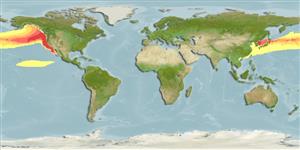
Pélagique. Subtropical; 90°N - 10°N, 180°W - 180°E
Pacific Ocean: Eastward across the Pacific between 34° and 47°N, extending north to 55°N, 145°W, in the Gulf of Alaska (Ref. 1522).
Longueur à la première maturité / Taille / Poids / Âge
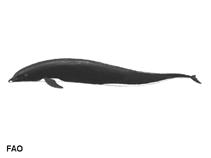
Maturité: Lm ? range ? - ? cm Max length : 310 cm TL mâle / non sexé; (Réf. 1394); 230 cm TL (female); poids max. publié: 115.0 kg (Réf. 1394)
Inhabits cold and warm temperate regions. Feeds on squid and lanternfish; but also feeds on a variety of surface and mid-water species (Ref. 1394). Inhabits cold and warm temperate regions. Feeds on squid and lanternfish; but also feeds on a variety of surface and mid-water species (Ref. 1394).
Cycle de vie et comportement reproducteur
Maturité | Reproduction | Frai | Œufs | Fécondité | Larves
Jefferson, T.A., S. Leatherwood and M.A. Webber 1993 FAO species Identification Guide: Marine Mammals of the World. Rome, FAO. 320 p. + 587 figures. (Réf. 1394)
Statut dans la liste rouge de l'IUCN
(Réf. 130435: Version 2025-2 (Global))
statut CITES (Réf. 108899)
Not Evaluated
Menace pour l'homme
Utilisations par l'homme
Pêcheries: commercial
FAO - pêcheries: Résumé espèce, landings search; Publication: search | FishSource | Sea Around Us
Outils
Plus d'informations
Écologie trophiqueAliments (proies)Composition du régime alimentaireConsommation alimentairePrédateurs Dynamique des populationsCroissance
Âges / tailles maximales
Longueur-poids rel.
Rel. longueur-longueur.
Fréquences de longueurs
Conversion de masse
Abondance
Cycle de vieReproductionMaturitéFéconditéFraiŒufsDéveloppement de l'œufLarves PhysiologieConsommation d'oxygène
Liées à l'hommeTimbres, pièces de monnaie, divers
Sources Internet
Estimations basées sur des modèles
Vulnérabilité de la pêche
(Réf. 71543) |
Very high vulnerability (90 of 100). |
Catégorie de prix
(Réf. 80766): |
Unknown. |