Mammalia |
Cetartiodactyla |
Delphinidae
Environnement : milieu / zone climatique / profondeur / gamme de distribution
Écologie
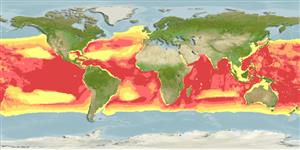
Pélagique; océanodrome (Réf. 75906); profondeur 0 - 3793 m (Réf. 94963), usually 500 - 1100 m (Réf. 80612). Tropical; 90°N - 90°S, 180°W - 180°E
Atlantic Ocean and Indo-Pacific.
Longueur à la première maturité / Taille / Poids / Âge
Maturité: Lm ?, range 210 - 220 cm Max length : 270 cm TL mâle / non sexé; (Réf. 1394); poids max. publié: 210.0 kg (Réf. 1394)
Description synthétique
Morphologie
Robust. Short beak, subtriangular to weakly falcate dorsal fin, pointed flippers, and relatively small concave flukes. Dark bluish to brownish-gray dorsal cape, pale gray flank, and white to pinkish belly. Wide dark gray to black stripe extending from the eye to the anus, conspicuously set off by thin pale cream-colored borders.
Pantropical distribution. Dolphins are directly caught for use as shark-bait in Sta. Ana and Aparri, Philippines (Ref. 77119). Minimum depth from Ref. 116169. Often seen near shore, along the outer continental shelf and in deep oceanic waters (Ref. 80620). Feeds in deep waters (Ref. 122680). Feeds on mid-water fish, squid and crustaceans (Ref. 1394). Forms large social groups (Ref. 122680). Occasionally sighted with melon-headed whales, Peponocephala electra. (Ref. 80612).
Cycle de vie et comportement reproducteur
Maturité | Reproduction | Frai | Œufs | Fécondité | Larves
Does not show strong evidence of seasonality in calving (Ref. 80616).
Tan, J.M.L. 1995 A Field Guide to the Whales and Dolphins in the Philippines. Makati City: Bookmark. 125 p. (Réf. 936)
Statut dans la liste rouge de l'IUCN
(Réf. 130435: Version 2025-2 (Global))
statut CITES (Réf. 108899)
Menace pour l'homme
Utilisations par l'homme
Pêcheries: commercial; appât: usually
FAO - pêcheries: Résumé espèce; Publication: search | FishSource | Sea Around Us
Outils
Plus d'informations
Dynamique des populations PhysiologieConsommation d'oxygène
Liées à l'hommeTimbres, pièces de monnaie, divers
Sources Internet
Estimations basées sur des modèles
Résilience
(Ref. 69278): |
Haut, temps minimum de doublement de population inférieur à 15 mois (K=0.48; tm=8) |
Vulnérabilité de la pêche
(Réf. 71543) |
High to very high vulnerability (71 of 100). |
Catégorie de prix
(Réf. 80766): |
Unknown. |