Mammalia |
Cetartiodactyla |
Delphinidae
Entorno: milieu / zona climática / rango de profundidad / gama de distribución
Ecología
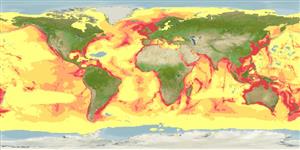
Pelágico; oceanodromo (Referencia 75906); rango de profundidad 0 - 1316 m (Referencia 116169). Subtropical
096675 Tursiops truncatus ponticus Endemic to Black Sea.int
Longitud en la primera madurez / Tamaño / Peso / Edad
Madurez: Lm ?, range 240 - 260 cm Max length : 380 cm TL macho / no sexado; (Referencia 1394); peso máximo publicado: 650.0 kg (Referencia 1394)
Descripción breve
Morfología
This coastal subspecies (Tursiops truncatus geyphyreus) can be distinguished from the nominate offshore subspecies (Tursiops truncatus truncatus) by the following diagnosable cranial features: W-shaped border of the antorbital notch (vs. U-shaped); barely or not visible interparietal bone (vs. clearly visible); cranial vertex from the posterior end of nasals to the nuchal crest is short and rectangular (vs. long and squared); left nasal bone noticeably smaller and more compressed antero-posteriorly than the right (vs. nearly symmetrical); Falciform lateral margin of the ascending process of right premaxilla (vs. straight or slightly concave); lateral margin of the ascending process of the maxillae over the preorbital process is deflected dorsally (vs. flat) (Ref. 128824).
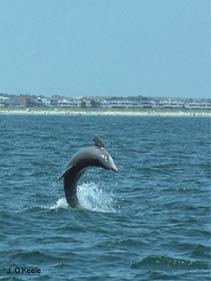
Preyed upon by great white sharks (Ref. 32140). Dolphins are directly caught for use as shark-bait in Sta. Ana and Aparri, Philippines (Ref. 77119). Found primarily in coastal and inshore regions of tropical and temperate waters of the world (Ref. 936) and deeper channels between islands (Ref. 122680). Also inhabits pelagic waters, such as those in the eastern tropical Pacific (Ref. 936). In herds of less than 20 individuals (Ref. 801). Feeds either cooperatively or in solitary. They can obtain prey via 'fish whacking' and steering fish onto mudflats (Ref. 122680). Feeds on fish (Refs. 801, 936) crustaceans, and cephalopods (Ref. 801).
Ciclo vital y comportamiento de apareamiento
Madurez | Reproducción | Puesta | Huevos | Fecundidad | Larva
Tan, J.M.L. 1995 A Field Guide to the Whales and Dolphins in the Philippines. Makati City: Bookmark. 125 p. (Referencia 936)
Situación en la Lista Roja de la UICN
(Referencia 130435: Version 2025-2 (Global))
Estatus CITES (Referencia 108899)
CMS (Referencia 116361)
Amenaza para el ser humano
Usos humanos
Pesquerías: comercial; carnada: usually
FAO - pesquerías: perfil de la especie, landings search; Publication: search | FishSource | Sea Around Us
Herramientas
Más información
FisiologíaConsumo del oxígeno
Relacionados con el ser humanoSellos, monedas, varios
Fuentes de Internet
Estimaciones basadas en modelos
Resiliencia
(Ref. 69278): |
Alto, población duplicada en un tiempo mínimo inferior a 15 meses (K=0.14-0.48; tm=8.5) |
Vulnerabilidad pesquera
(Referencia 71543) |
Very high vulnerability (76 of 100). |
Categoría de precios
(Referencia 80766): |
Unknown. |