Mammalia |
Cetartiodactyla |
Balaenidae
Environnement : milieu / zone climatique / profondeur / gamme de distribution
Écologie
Pélagique; océanodrome (Réf. 75906); profondeur 0 - 175 m (Réf. 137958). Temperate; 67°N - 60°S, 180°W - 180°E
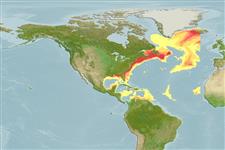
North Atlantic: Balaena glacialis glacialis: Davis Strait, Denmark Strait, Norwegian Sea south to Massachusetts and the Bay of Biscay, south to Florida and the Golfo de Cintra, Western Sahara, Gulf of Mexico, Sea of Okhotsk, southern Bering Sea, northern Gulf of Alaska, south to the Sea of Japan, Pacific coast of northern Honshu and the coast of central California, Taiwan, Baja California Sur, Hawaiian Islands; Balaena glacialis australis: Subantarctic zone, between 35° to 40°S and 55° to 60°S, southern Brazil to northern Argentina, Tristan da Cunha, Namibia, southern Mozambique to Cape Province, St Paul Island, Southwest and southeast Australia, Kermadec Island, central Chile (Ref. 1522). Temperate, subpolar.
Longueur à la première maturité / Taille / Poids / Âge
Maturité: Lm ?, range 1,250 - 1550 cm Max length : 1,800 cm TL mâle / non sexé; (Réf. 1394); poids max. publié: 100.0 t (Réf. 1394)
Description synthétique
Morphologie
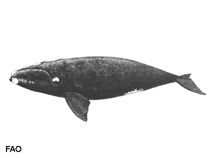
The northern right whale is one of the stockiest of all whales. It has a massive head that can be up to nearly one-third of its body length. The jaw line is arched and the upper jaw is very narrow in dorsal view. The flippers are broad and tend to be more fan-shaped than the pointed flippers of most other cetaceans. There is no dorsal fin or dorsal ridge on the broad back. The flukes are very wide and smoothly tapered, with a smooth trailing edge and a deep notch. Most right whales are predominantly black, but there may be large white splotches of varying extent on the belly and chin. The head is covered with callosities, areas of roughened skin to which whale lice and sometimes barnacles attach. The largest of these callosities, on the top of the rostrum, is called the bonnet. The widely separated blowholes produce a Vshaped blow up to 5 m high. Inside the mouth are 200 to 270 long thin baleen plates. Which may reach nearly 3 m in length. They are brownish grey to black in colour. The fringes of these plates are very fine, reflecting the small prey taken by this species.
Minimum depth from Ref. 116169.
The right whales were the first targets of commercial whaling, starting in the eleventh century. They were sought after because of their thick blubber layer (and thus high yield of oil), long flexible baleen (used for many of the same purposes as plastic is today), slow swimming speeds, and tendency to float when killed. North Pacific right whales were depleted to near extinction by commercial whaling, the most recent episodes of which occurred as scientific whaling about 20 years ago. Sightings today are rare, apparently the species is not recovering, even under full protection (Ref. 1394). Calving and feeding areas throughout the world are most often in shallow nearshore regions. Seen in groups of less than 12 (most often singles or pairs). Feed on copepods and other small invertebrates, generally by slowly skimming through patches of concentrated prey at or near the surface (Ref. 1394). It is preyed upon by the sevengill shark (Ref. 8910).
Cycle de vie et comportement reproducteur
Maturité | Reproduction | Frai | Œufs | Fécondité | Larves
The mating system appears to involve sperm competition (males competing to inseminate females, not so much by physical aggression, as by delivering large loads of sperm, thereby displacing that of other males). Young are born in winter and spring in tropical or subtropical breeding areas.
Jefferson, T.A., S. Leatherwood and M.A. Webber 1993 FAO species Identification Guide: Marine Mammals of the World. Rome, FAO. 320 p. + 587 figures. (Réf. 1394)
Statut dans la liste rouge de l'IUCN
(Réf. 130435: Version 2025-2 (Global))
statut CITES (Réf. 108899)
Menace pour l'homme
Utilisations par l'homme
Pêcheries: hautement commercial
FAO - pêcheries: Résumé espèce, landings search; Publication: search | FishSource | Sea Around Us
Outils
Plus d'informations
Dynamique des populations PhysiologieConsommation d'oxygène
Liées à l'hommeTimbres, pièces de monnaie, divers
Sources Internet
Estimations basées sur des modèles
Résilience
(Ref. 69278): |
Faible, temps minimum de doublement de population : 4,5 à 14 années (K=0.1; tm=10) |
Vulnérabilité de la pêche
(Réf. 71543) |
Very high vulnerability (84 of 100). |
Catégorie de prix
(Réf. 80766): |
Unknown. |