Mammalia |
Cetartiodactyla |
Balaenopteridae
Miljö: miljö / Klimatzon / djupintervall / distributionsområde
Ekologi
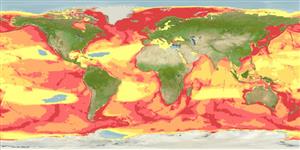
Pelagic-neritic; brackvatten; djupintervall 0 - 732 m (Ref. 116169). Tropical; 90°N - 90°S, 180°W - 180°E
Circumglobal: Balaenoptera acutorostrata acutorostrata: North Atlantic; Balaenoptera acutorostrata scammoni: North Pacific (Ref. 1522).
Längd vid första mognad / Storlek / Vikt / Ålder
Könsmognad: Lm ? range ? - ? cm Max length : 1,070 cm TL hane/ej könsbestämd; (Ref. 1394); 1070 cm TL (female); publicerad maxvikt: 14.0 t (Ref. 1394)
Distributed from the tropics to the ice edges in both hemispheres. They can be seen offshore, and more often in coastal and inshore areas. They are rarely seen in some tropical pelagic areas. Minimum depth from the Pacific (Ref. 83490) and maximum depth based from their food in the Atlantic (Ref. 83488). Feeds on krill and small schooling fishes (Ref. 1394). Oceanodromous (Ref. 75906). Distributed from the tropics to the ice edges in both hemispheres. They can be seen offshore, and more often in coastal and inshore areas. They are rarely seen in some tropical pelagic areas (Ref. 1394). They are known to be 'gulpers,' feeding in separate events, often lunging at large schools of fish (Ref. 122680). Also feeds on krill (Ref. 1394). Oceanodromous (Ref. 75906).
Livscykel och parningsbeteende
Könsmognad | Reproduktion | Lek | Ägg | Fekunditet | Larver
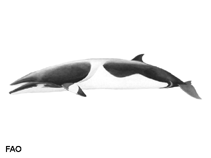
Jefferson, T.A., S. Leatherwood and M.A. Webber 1993 FAO species Identification Guide: Marine Mammals of the World. Rome, FAO. 320 p. + 587 figures. (Ref. 1394)
Status på IUCN:s rödlista
(Ref. 130435: Version 2025-2 (Global))
CITES-status (Ref. 108899)
Not Evaluated
Hot mot människor
Mänskliga användningsområden
Fiskeri: kommersiell
FAO - fiskeri: artprofil, landings search; Publication: search | FishSource | Havet omkring oss
Verktyg
Ytterligare information
MänniskorelateradFrimärken, mynt, diverse.
Internet-källor
Uppskattningar baserade på modeller
Resiliens
(Ref. 69278): |
Mellan, lägsta populationsfördubblingstid 1,4-4,4 år (K=0.17; tm=8) |
Sårbarhet i fisket
(Ref. 71543) |
Very high vulnerability (79 of 100). |
Priskategori
(Ref. 80766): |
Unknown. |