Mammalia |
Carnivora |
Otariidae
Environnement : milieu / zone climatique / profondeur / gamme de distribution
Écologie
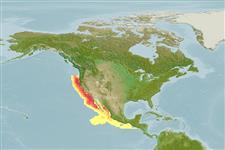
Bathydémersal. Subtropical; 45°N - 13°N, 140°W - 180°E
Eastern Central Pacific: USA and Mexico.
Longueur à la première maturité / Taille / Poids / Âge
Maturité: Lm ? range ? - ? cm Max length : 190 cm TL mâle / non sexé; (Réf. 1394); 140 cm TL (female); poids max. publié: 170.0 kg (Réf. 1394); poids max. publié: 170.0 kg
Description synthétique
Morphologie
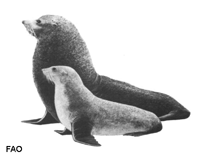
Dusky black with lighter ventrum. Gray head and shoulders, black nose with brown-red hair around the eyes. Guard hairs are white-tipped in adult males. Claws present in 5 fingers and absent on the 1st and 5th toes. Cartilaginous webbing extends past the claws. Females have 2 pairs abdominal nipples.
Found at sea, on beaches; when ashore, they prefer volcanic caves and grottos, or other rocky habitats. Found at sea, on beaches; when ashore, they prefer volcanic caves and grottos, or other rocky habitats. Both male and female territorial. Extralimital sightings in California corresponds with El Niño events (Ref. 1394).
Cycle de vie et comportement reproducteur
Maturité | Reproduction | Frai | Œufs | Fécondité | Larves
Breeds near or in caves marked by the male as his territory. Mating occurs postpartum. Pups nurse for 9 to 11 months during which nursing females fast for an average of 5 days.
Jefferson, T.A., S. Leatherwood and M.A. Webber 1993 FAO species Identification Guide: Marine Mammals of the World. Rome, FAO. 320 p. + 587 figures. (Réf. 1394)
Statut dans la liste rouge de l'IUCN
(Réf. 130435: Version 2025-2 (Global))
statut CITES (Réf. 108899)
Not Evaluated
Menace pour l'homme
Utilisations par l'homme
Pêcheries: commercial
FAO - pêcheries: Résumé espèce; Publication: search | FishSource | Sea Around Us
Outils
Plus d'informations
Dynamique des populationsCroissanceÂges / tailles maximalesLongueur-poids rel.Rel. longueur-longueur.Fréquences de longueursConversion de masseAbondance Cycle de vieReproductionMaturitéFéconditéFraiŒufsDéveloppement de l'œufLarves PhysiologieConsommation d'oxygène
Liées à l'hommeTimbres, pièces de monnaie, divers
Sources Internet
Estimations basées sur des modèles
Vulnérabilité de la pêche
(Réf. 71543) |
Very high vulnerability (90 of 100). |
Catégorie de prix
(Réf. 80766): |
Unknown. |