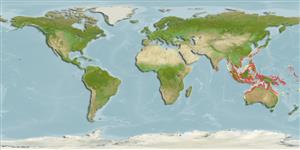
Not assigned |
Squamata |
Acrochordidae
Milieu: milieu / Klimaatzone / Diepte / verspreidingsgebied
Ecologie
Benthopelagisch; brak water; diepte 4 - 20 m (Ref. 2413). Tropical
Indo-West Pacific.
Lengte bij maturiteit / Grootte / Gewicht / Leeftijd
Maturiteit: Lm 58.0 range ? - ? cm Max length : 81.0 cm SVL mannelijk / geslacht onbekend; (Ref. 2413)
This species has small scales with tubercle-like keels, and a stout and compressed body. Females grow to a larger size than males.
Length based on occurrence record; to be replaced with a better reference. Nocturnal. Feeds on gobies and occasionally on marine crustaceans (Ref. 2413). Usually found in inshore waters, estuaries, and tidal rivers (Ref. 78651).
Levenscyclus en paargedrag
Maturiteit | Voortplanting | Paaien | Eieren | Fecunditeit | Larven
Breeding season begins in July (end of monsoon season) to December in Phangnga Bay. Clutch size averaged 5.18 -/+ 0.37 individuals and increased with maternal body size.
Wangkulangkul, S., K. Thirakhupt and H.K. Voris 2005 Sexual size dimorphism and reproductive cycle of the little file snake Acrochordus granulatus in Phangnga Bay, Thailand. Science Asia 31:257-263. (Ref. 2413)
Status op de Rode Lijst van het IUCN
(Ref. 130435: Version 2025-2 (Global))
CITES status (Ref. 108899)
Not Evaluated
Not Evaluated
Gevaar voor de mens
Gebruik door de mens
Visserij: van geen belang
FAO - Publication: search | FishSource |
Tools
Meer informatie
FysiologieZuurstofverbruik
Menselijk gerelateerdPostzegels, munten, diversen.
Internetbronnen
Schattingen op basis van modellen
Weerstandsvermogen
(Ref. 69278): |
Hoog, minimale populatieverdubbelingstijd minder dan 15 maanden (K=0.83-1.39) |
Kwetsbaarheid van de visserij
(Ref. 71543) |
Low to moderate vulnerability (33 of 100). |
Prijsklasse
(Ref. 80766): |
Unknown. |