Reptilia |
Squamata |
Iguanidae
Milieu: milieu / Klimaatzone / Diepte / verspreidingsgebied
Ecologie
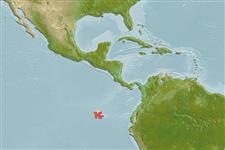
Rifbewoner; diepte 0 - 12 m (Ref. 2658). Tropical; 10°C - 36°C (Ref. 2620); 1°N - 2°S, 92°W - 89°W
Southeast Pacific: Galapagos Islands. IUCN: Amblyrhynchus cristatus albemarlensis, Vu B2ab(iii)c(iv); Amblyrhynchus cristatus hassi, Vu B2ac(iv); Amblyrhynchus cristatus mertensi, En A2ce; C2b; Amblyrhynchus cristatus nanus, En A2b; Amblyrhynchus cristatus sielmanni, Vu B2ac(iv); and Amblyrhynchus cristatus venustissimus, Vu B2ac(iv) (Ref. 89710).
Lengte bij maturiteit / Grootte / Gewicht / Leeftijd
Maturiteit: Lm ? range ? - ? cm Max length : 130 cm TL mannelijk / geslacht onbekend; (Ref. 2621); 60 cm TL (female); max. gepubliceerd gewicht: 1.5 kg (Ref. 2621)
Weight ranges from 500 to 1,500 g (Ref. 2621). Ectothermic (Ref. 2648). Prefers temperatures between 35° to 37°C (Ref. 2659). Lives in colonies where shallow reefs occur with extensive intertidal zone and rocky coastline with 2 to 5 m above sea level. Lays eggs in softer substrates (Ref. 2623). Sleeps on the coastline or up on mangrove trees. Exhibits subtidal and intertidal feeding (Ref. 2650). Naturally dives at depths 1.5 to 5 m for 5 to 10 minutes (Ref. 2656) but can descend to 12 m for about 30 minutes (Ref. 2658).
Levenscyclus en paargedrag
Maturiteit | Voortplanting | Paaien | Eieren | Fecunditeit | Larven
Exhibits lekking during mating season (Ref. 2652). Nesting season is from January to February. Males defend mating territories for 3 months during annual breeding season. Females lay up to 6 eggs in burrows 30 to 80 cm deep in sand or volcanic ash (Ref. 2661). Embryo development takes place at temperatures from 28° to 30°C (Ref. 2659).
Roy, K. 2000 Amblyrhynchus cristatus. Animal Diversity Web. http://animaldiversity.ummz.umich.edu/site/accounts/information/Amblyrhynchus_cristatus.html. [Accessed 30/01/07]. (Ref. 2618)
Status op de Rode Lijst van het IUCN
(Ref. 130435: Version 2025-2 (Global))
CITES status (Ref. 108899)
Not Evaluated
Gevaar voor de mens
Gebruik door de mens
FAO - Publication: search | FishSource |
Tools
Meer informatie
FysiologieZuurstofverbruik
Menselijk gerelateerdPostzegels, munten, diversen.
Internetbronnen
Schattingen op basis van modellen
Weerstandsvermogen
(Ref. 69278): |
Hoog, minimale populatieverdubbelingstijd minder dan 15 maanden (K=0.74-1.52; tm=5.5) |
Kwetsbaarheid van de visserij
(Ref. 71543) |
Moderate to high vulnerability (50 of 100). |
Prijsklasse
(Ref. 80766): |
Unknown. |