Not assigned |
Testudines |
Cheloniidae
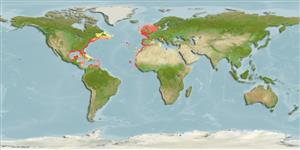
পরিবেশ: পরিবেশ / জলবায়ু অঞ্চল / গভীরতার পরিসীমা / বিতরণ পরিসীমা
বাস্তুসংস্থান
তলদেশ বিহারী; গভীরতার পরিসীমা 0 - 50 m (সূত্র 138107). Tropical; 60°N - 9°N, 98°W - 17°E
Atlantic Ocean and the Mediterranean: from Mexico, south to Venezuela,, north to UK and east to Italy .
প্রথম পরিপক্কতার সময় দৈর্ঘ্য / আকৃতি / ওজন / বয়স
পরিপক্কতা : Lm 60.0 range ? - ? cm Max length : 74.8 cm CL পুরুষ/ লিঙ্গ অনিধর্ারিত ; (সূত্র 74991); 65.7 cm CL (female); common length : 65.6 cm CL পুরুষ/ লিঙ্গ অনিধর্ারিত ; (সূত্র 1397); সবের্াচ্চ প্রকাশিত ওজন : 0.00 g
Body mass lower than 50,000 g. Carapace of adults are nearly round. Head: moderate-sized; subtriangular. Hatchlings: longer carapace and larger head. As it grows, carapace changes its shape and becomes a little wider. Head with 2 pairs of prefrontal scales. Carapace: with 5 central, 5 pairs of lateral and 12 pairs of marginal scutes; bridge areas have 4 scutes. Each with a pore which is the opening of the Rathke’s gland. This gland plays a pheromonal role in maintaining the integrity of the massed nesting assemblage of females just off the beaches in which it releases an odoriferous substance before and during their arrival. One visible claw on fore flippers; hatchlings show two, in rear flippers 1 or 2 claws. Color: in adults, plain olive-grey dorsally, white or yellowish underneath; in hatchlings, jet black when wet; changes significantly with age; after 10 months, plastron is nearly white.
One of the smallest of the sea turtles. Usually inhabits sandy and muddy bottoms that are rich in crustaceans. A carnivorous species mostly feeds on crustaceans, mollusks, fishes and vegetable fragments. Mating season occurs from April to the end of July. Females are occasionally escorted or seen mating at the near surf area. This turtle are known to be day-time nesters and mass nesting takes place on windy days. The females lay eggs from 1.4 to 1.55 times each season with a number of 102 eggs per clutch. Incubation period lasts for 45 to 58 days depending on temperature and humidity. Commercial exploitation of this species is not allowed throughout its distribution range (Ref. 1397). Usually inhabits sandy and muddy bottoms that are rich in crustaceans (Ref. 1397). A carnivorous species that mostly feeds on crustaceans, mollusks, fishes, vegetable fragments and so on.
জীবনচক্র এবং প্রজনন আচরণ
পরিপক্কতা | প্রজনন | ডিম ছাড়া | ডিমসমূহ | ডিম্বধারন ক্ষমতা | শুককীট
Mating season occurs from April to the end of July. Females are occasionally escorted or seen mating at the near surf area. This turtle are known to be day-time nesters and mass nestings takes place on windy days. The females lay eggs from 1.4 to 1.55 times each season with a number of 102 eggs per clutch. Eggs looks like ping-pong balls with size ranging between 3.4 and 4.5 cm; and weigh from 24 to 40 g. Incubation period lasts for 45 to 58 days depending on temperature and humidity (Ref. 1397). Temperature-dependent Sex Determination (TSD) is demonstrated in this species (Ref. 83971).
Hirth, H.F. 1993 Chapter 10. Marine turtles. pp. 329-370. In A. Wright and L. Hill (eds) Nearshore marine resources of the South Pacific. Forum Fisheries Agency (Honiara), Institute of Pacific Studies (Suva) and International Centre for Ocean Development (Canada), 710 p. (সূত্র 97534)
আইইউসিএন রেড লিস্টের অবস্থা
(সূত্র 130435: Version 2025-2 (Global))
CITES অবস্থা (সূত্র 108899)
মানুষের জন্য হুমকি
মানুষের ব্যবহার
মৎস্য: বাণিজ্যিক
FAO - Publication: search | FishSource | আমাদের চতুর্পাশ্বের সাগর
হাতিয়ার
আরো তথ্য
শারীরবিদ্যাঅম্লজান ব্যবহার
মানব সম্পর্কিতডাকটিকিট, মুদ্রা, বিবিধ।
ইন্টারনেট সুত্র
মডেলের উপর ভিত্তি করে অনুমান
স্থিতিস্থাপক
(Ref. 69278): |
উচ্চ, সর্বনিম্ন প্রজন দ্বিগুনের সময় ১৫ মাস (K=0.13-1.3; tm=9.5) |
মাছ ধরার ঝুঁকিপূর্ণতা
(সূত্র 71543) |
Moderate to high vulnerability (48 of 100). |
মূল্য বিভাগ
(সূত্র 80766): |
Unknown. |