-

- About this page
- Languages
-
Feedback
- Citation
- Upload
-
Related species
- Species in
Dermochelys - Species in
Dermochelyidae - - Classification -
- Dermochelyidae
- Testudines
- Not assigned
- Chordata
- Animalia
- Species in
-



Dermochelys coriacea (Vandelli, 1761)
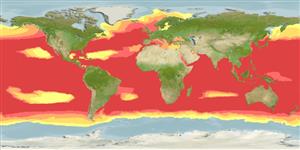
Leatherback turtle| Native range | All suitable habitat | Point map | Year 2050 |
|
| This map was computer-generated and has not yet been reviewed. |
| Dermochelys coriacea AquaMaps Data sources: GBIF OBIS |
Classification / Names Common names | Synonyms | CoL | ITIS | WoRMS
Not assigned | Testudines | Dermochelyidae
Environment: milieu / climate zone / depth range / distribution range Ecology
Benthopelagic; depth range 0 - 1250 m (Ref. 78668), usually 0 - 200 m (Ref. 78668). Tropical; 72°N - 49°S, 180°W - 180°E (Ref. 1397)
Distribution Countries | FAO areas | Ecosystems | Occurrences | Introductions
Circumglobal.
Length at first maturity / Size / Weight / Age
Maturity: Lm 121.0 range ? - ? cm Max length : 257 cm CL male/unsexed; (Ref. 1397); common length : 916,000 cm CL male/unsexed; (Ref. 1397); max. published weight: 650.0 kg (Ref. 99323)
Short description Morphology
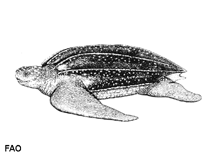
Color is uniformly dark. Shell not as solid; with 5 longitudinal ridges; approximately 2 m or more. Lacks firm internal skeleton.
Deepest dive recorded based on Ref. 86780, usually epipelagic (Refs. 78668, 85378). They are commonly found in the upper 200 m (Ref. 85786). Hatchlings and juveniles are assumed to be pelagic, migrating in search of food. Adults mainly feed on pelagic invertebrates, e.g., jellyfishes, tunicates, crustaceans and juvenile fishes. In some places it is used as bait for long line shark fisheries but this species have no commercial fisheries (Ref. 1397), although pelagic fisheries has been identified as a major source of its mortality (Ref. 85378). An example of this is the 1.4 million hooks deployed in the Atlantic daily (Ref. 85362). Declining populations have been reported in the Pacific (Ref. 85365). For conservation purposes, breeding interval between regions is important to note. The interval is generally longer in the Pacific than in the Atlantic and can be up to 7 years (Ref. 86781). Knowledge on leatherback turtle movements is important to determine areas where they may at high risk due to fisheries (Ref. 85378). Also, population estimates needs to be based on years of monitoring since each female only nests every few years (Ref. 85379). Usually found in deep, highly productive waters, occurring in waters far colder than that inhabited by other sea turtle species (Ref. 122680). Omnivorous; inhabiting the open sea (Ref. 79544). This is known to have a wide range of foraging area in the open ocean (Ref. 83887), wherein ocean currents take part in. Deepest dive is recorded at 1,230 m. Residence of this species is related to enhanced prey availability in a particular area (Ref. 85378). This is supported by data showing shallow near surface day and night diel dive patterns of leatherbacks in relation to their zooplankton prey exhibiting diel vertical migration that are both observed in high latitudes of the Atlantic and the tropics. This movement pattern may be a search strategy of leatherbacks for patchily distributed prey that can be foraged from near surface to about 200 m (Ref. 85786). Suitable habitat with prey availability is observed at temperatures of >15 °C as seen in South Africa (Ref. 85789). In the southern Atlantic, observed migration to feeding grounds were found to be 150 days to complete. Once the turtle reaches a food-rich habitat, it may stay there for about 5 years before it goes back to its origin before migration (Ref. 85867). Little information exists on the feeding behavior of post-hatchling and juvenile leatherback sea turtles living in pelagic habitats. They are likely deemed to be exclusively carnivorous (Ref. 122680). Adults feed solely on jellyfish (Ref. 118629).
Life cycle and mating behavior Maturity | Reproduction | Spawning | Eggs | Fecundity | Larvae
Mating usually lasts for 20 minutes. Nesting cycle varies from latitude and geographical characteristics of the coast. Nesting cycle is 2 or 3 years which usually lays 61 to 126 eggs per clutch for 4 or 5 times per season. Incubation period varies from 50 to 78 days depending on temperature and humidity. Survival rate is lower if incubation period is shorter.
Main reference
References | Coordinator | Collaborators
Hirth, H.F. 1993 Chapter 10. Marine turtles. pp. 329-370. In A. Wright and L. Hill (eds) Nearshore marine resources of the South Pacific. Forum Fisheries Agency (Honiara), Institute of Pacific Studies (Suva) and International Centre for Ocean Development (Canada), 710 p. (Ref. 97534)
IUCN Red List Status
(Ref. 130435: Version 2025-1)
Vulnerable (VU) (A2bd); Date assessed: 21 June 2013
CITES status (Ref. 108899)
Appendix I: International trade banned
CMS (Ref. 116361)
Appendix I & II: Endangered migratory species conserved through agreements
Threat to humans
Human uses
Fisheries: commercial
| FishSource | Sea Around Us
Tools
More information
Trophic Ecology
Ecology
Population dynamics
Growth
Max. ages / sizes
Length-weight rel.
Length-length rel.
Length-frequencies
Mass conversion
Abundance
Max. ages / sizes
Length-weight rel.
Length-length rel.
Length-frequencies
Mass conversion
Abundance
Life cycle
Distribution
Physiology
Oxygen consumption
Human Related
Stamps, coins, misc.
Outreach
References
Internet sources
BHL | BOLD Systems | CISTI | DiscoverLife | FAO(Publication : search) | Fishipedia | GenBank (genome, nucleotide) | GloBI | Gomexsi | Google Books | Google Scholar | Google | PubMed | Tree of Life | Wikipedia (Go, Search) | Zoological Record
Estimates based on models
Preferred temperature
(Ref. 115969): 3.1 - 28.9, mean 20 (based on 10218 cells).
Resilience
(Ref. 69278):
Low, minimum population doubling time 4.5 - 14 years (K=0.03-0.14; tm=16.1).
Price category
(Ref. 80766):
Unknown.