Not assigned |
Testudines |
Cheloniidae
环境:氛围 / 气候带 / 深度上下限 / 分布范围
生态学
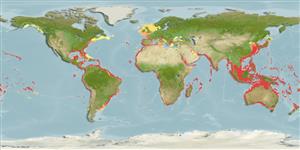
大洋性; 深度上下限 0 - 200 m (参考文献 417). Tropical; 61°N - 53°S, 180°W - 180°W
Circumglobal.
首次成熟时的长度 / 大小 / 重量 / 年龄
成熟度: Lm ?, range 88 - 99 cm Max length : 105 cm CL 雄鱼/尚未辨别雌雄; (参考文献 417); common length : 90.0 cm CL 雄鱼/尚未辨别雌雄; (参考文献 417); 最大体重: 386.4 kg (参考文献 138263)
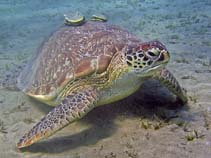
Smaller species under genus Chelonia. Adults carapace are strongly elevated or vaulted. In large females, carapace is less round profile in frontal view than in Chelonia mydas. In dorsal view, carapace is subcardiform and slightly emarginate over the neck and fore flippers, and deeply emarginate over the rear flippers. In subadults and young turtles, indentations are present in the last third of the carapace between each marginal scute. The carapace width 76 to 82% of its straight-line length (SCL), usually becomes narrower with age. The head is small and blunt. Carapacial scutes have 5 centrals, 4 pairs of laterals and 11 pairs of marginals. In ventral view, on the plastron, the scutes are less thick than those of the carapace. Scute counts 6 pairs plus 4 inframarginals at each side. Head with one pair of elongated prefrontal scales and 4 postorbital scales at each side (variable from 2 to 5). Tomium of lower jaw serrated. Serrations corresponds with strong ridges on the inner surface of the upper tomium. Each flipper at the outer border has a single visible claw. Adults color in dorsal view are dark. Carapace slate grey to black, with a blotched or radiating brown and olive pattern, with or without yellow radiating stripes; upper surfaces of the head and flippers plain dark. Plastron varying from whitish grey to bluish or olive-grey. Young individuals are more colorful and brighter. Some adult turtles have the carapace covered by a coat of microscopic green algae, giving a lustreless greenish color. Hatchlings carapace and flippers dorsally are very dark brown or black with a narrow white border; ventrally white same as Chelonia mydas.
The total catches in 1987 are: 864 metric tons for FAO area 77 and 305 metric tons for FAO area 87 (Ref. 1397). Exploited for their eggs, shell, and flesh that are used for food and medicinal purposes (Ref. 85371). Considered to be the best species for commercial ranching or farming but capturing green turtles was forbidden; although for some areas, it still persists. Inadvertently caught in trawls (Ref. 1397). This species is not at risk of global extinction, rather subpopulations in different areas may become extinct if not dealt with, thus regional population listings are important for better conservation assessments (Ref. 83887). A typical solitary nektonic animal which usually feeds at shallow water areas where seagrasses or algae is abundant (Ref. 417). Feeds on algae and seagrasses (Ref. 97534). Home ranges for individuals feeding on algae is larger than individuals feeding on seagrass (Ref. 66638). Adults are known to be herbivorous while hatchlings to juvenile sizes are assumed to be carnivorous which has faster growth rates. When they get big enough, mostly capable of avoiding predators, they shift to a herbivorous diet (Ref. 417). Adults spend their adult life in foraging grounds which is often in great distance from nesting grounds (Ref. 66637). This results in a great energy cost from transport and fasting during the travel, thus females are observed to rest on the sea floor between nestings (Ref. 85359). Since mating occurs at sea, courting and copulation behavior are observed near nesting beaches and males are described to display and elaborate courtship behavior (Ref. 66637). In Hawaii beach-basking behavior was observed to facilitate temperature regulation (Ref. 81046). They have a swimming speed of 32km/hr (Ref. 83508). During nesting, females emerge from the water and creates a set of tracks one ascending to a successful nest or aborted digging while another extends as it descends to the sea (Ref. 83891). Post-nesting behavior shows a dominance of short dives mainly during open-ocean migration. This aids them in lessening their energy cost during transport, plus there is little food available in the open-ocean thus close to surface dives is observed. They also combine open-ocean and coastal routes for provision of foraging opportunities (Ref. 83560). Couplings of water temperature and their behavior is observed among this species (Ref. 85360).
生命周期和交配行为
成熟度 | 繁殖 | 产卵场 | 卵 | 孕卵数 | 仔鱼
Gonochorism. Two year breeding interval; can also breed in cycles of 1, 3 or 4 years or may switch from one cycle to another depending on age, food quantity and quality. Usually successive nestings are separated by two week intervals, which often lays 2 to 5 clutches per season. Nesting peaks differs in response to variations in localities (Ref. 1397). Mating system of green turtles is called scramble polygamy, which is when males competitively search for receptive females. Individual males are thus observed to mate with several females within the same season (Ref. 66637). Their secondary sexual characteristic is a longer prehensile tail with terminal nail, larger, recurved claws on the front flippers and a soft, more concave plastra (Refs. 85357, 85358). This characteristic is important for successful mounting in the face of intrasexual agonism, which is common for this species (Ref. 85356). Sexual dimorphism also exists for this species, males being a smaller size and females being larger. This helps males be efficient at foraging, defending their territories, and performing elaborate courtship displays which is favored by females. The larger size of females on the other hand, favors them since it allows them to lay more large-sized eggs (Ref. 66637).
主要参考文献
参考文献 | 合作者 | 合作者
Hirth, H.F. 1993 Chapter 10. Marine turtles. pp. 329-370. In A. Wright and L. Hill (eds) Nearshore marine resources of the South Pacific. Forum Fisheries Agency (Honiara), Institute of Pacific Studies (Suva) and International Centre for Ocean Development (Canada), 710 p. (参考文献 97534)
世界自然保护联盟红皮书
(参考文献 130435: Version 2025-2 (Global))
濒危 (EN) (A2bd); Date assessed: 30 April 2004
对人类的威胁
人类利用
渔业: 商业性; 水族馆: 商业性
FAO - Aquaculture Systems: production search渔业: 物种外形, landings search; Publication: search | FishSource | 周边海洋
工具
网络资源
基于模型的估算
回复力
(Ref. 69278): |
低的, 最小族群倍增时间4.5 - 14 年 (K=0.03-0.74; tm=29) |
渔业脆弱性
(参考文献 71543) |
High vulnerability (59 of 100). |
价格分类
(参考文献 80766): |
Unknown. |