Polyplacophora |
Chitonida |
Chitonidae
Milieu: milieu / Klimaatzone / Diepte / verspreidingsgebied
Ecologie
Benthic; diepte 0 - 1 m (Ref. 83435). Tropical
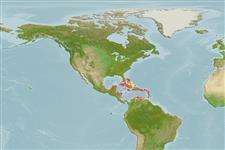
Western Central Atlantic.
Lengte bij maturiteit / Grootte / Gewicht / Leeftijd
Maturiteit: Lm ? range ? - ? cm Max length : 10.0 cm TL mannelijk / geslacht onbekend; (Ref. 289)
Maximum depth from Ref. 110502. Epibiotic (Ref. 110502). Intertidal; very common on open shore (Ref. 289); common in the zone between tides in the rocky coast, mainly on rocks of arenaceous; adheres with great force to rocks (Ref. 292); intertidal, spray zones of rocky shores (Ref. 2022, page 122).
Levenscyclus en paargedrag
Maturiteit | Voortplanting | Paaien | Eieren | Fecunditeit | Larven
Members of the class Polyplacophora are mostly gonochoric. Life cycle: Eggs hatch into lecitotrophic planktonic trocophore larvae (no veliger stage) which later metamorphose and settle on the bottom as young adults.
Burghardt, G. and L. Burghardt 2006 Selected Chitons of Caribbean Area and the East Coast of United States and Canada. A Gallery of Worlwide Chitons: http://home.inreach.com/burghart/eastcoas.html[accessed20/01/06] (Ref. 281)
Status op de Rode Lijst van het IUCN
(Ref. 130435: Version 2025-2 (Global))
CITES status (Ref. 108899)
Not Evaluated
Not Evaluated
Gevaar voor de mens
Gebruik door de mens
FAO - Publication: search | FishSource |
Tools
Meer informatie
Trofische ecologieVoedsel (prooien)
Dieetsamenstelling
Voedselconsumptie
Predatoren
PopulatiedynamicaGroei
Max. leeftijden / maten
Lengte-gewicht rel.
Lengte-lengte rel.
Lengtefrequenties
Massaconversie
Abundantie
LevenscyclusVoortplantingMaturiteitFecunditeitPaaienEierenOntwikkeling van de eierenLarven FysiologieZuurstofverbruik
Menselijk gerelateerdPostzegels, munten, diversen.
Internetbronnen
Schattingen op basis van modellen
Kwetsbaarheid van de visserij
(Ref. 71543) |
Low vulnerability (10 of 100). |
Prijsklasse
(Ref. 80766): |
Unknown. |