Cephalopoda |
Octopoda |
Octopodidae | Octopodinae
Miljö: miljö / Klimatzon / djupintervall / distributionsområde
Ekologi
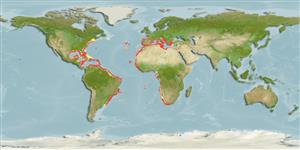
Benthic; djupintervall 25 - 750 m (Ref. 275). Tropical; 46°N - 36°S, 98°W - 37°E (Ref. 275)
Atlantic and the Mediterranean.
Längd vid första mognad / Storlek / Vikt / Ålder
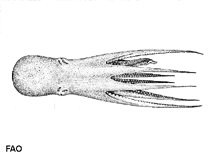
Könsmognad: Lm ?, range 11 - ? cm Max length : 11.0 cm ML hane/ej könsbestämd; (Ref. 275); 13 cm ML (female)
Maximum total length: 28.0 cm (Ref. 275). Maximum total length is 28 cm. Maximum depth from Ref. 110525. Found in the continental shelf (Ref. 110525).
Livscykel och parningsbeteende
Könsmognad | Reproduktion | Lek | Ägg | Fekunditet | Larver
Members of the class Cephalopoda are gonochoric. Male and female adults usually die shortly after spawning and brooding, respectively. Mating behavior: Males perform various displays to attract potential females for copulation. During copulation, male grasp the female and inserts the hectocotylus into the female's mantle cavity where fertilization usually occurs. Life cycle: Embryos hatch into planktonic stage and live for some time before they grow larger and take up a benthic existence as adults.
Turgeon, D.D., J.F. Quinn Jr., A.E. Bogan, E.V. Coan, F.G. Hochberg, W.G. Lyons, P.M. Mikkelsen, R.J. Neves, C.F.E. Roper, G. Rosenberg, B. Roth, A. Scheltema, F.G. Thompson, M. Vecchione and J.D. Willams 1998 Common and scientific names of aquatic invertebrates from the United States and Canada: Mollusks, 2nd ed. American Fisheries Society (Special publication 26), Bethesda, Maryland. 526 p. (Ref. 1667)
Status på IUCN:s rödlista
(Ref. 130435: Version 2025-2 (Global))
CITES-status (Ref. 108899)
Not Evaluated
Not Evaluated
Hot mot människor
Mänskliga användningsområden
Fiskeri: mindre kommeriell
FAO - Publication: search | FishSource |
Verktyg
Ytterligare information
Trofisk ekologiLivsmedelsartiklar (preys)
Födosammansättning
Födointag
Predatorer
MänniskorelateradFrimärken, mynt, diverse.
Internet-källor
Uppskattningar baserade på modeller
Sårbarhet i fisket
(Ref. 71543) |
Low vulnerability (10 of 100). |
Priskategori
(Ref. 80766): |
High. |