Cephalopoda |
Octopoda |
Octopodidae
Ambiente: milieu / zona climatica / distribuzione batimetrica / gamma di distribuzione
Ecologia
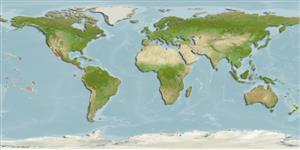
Benthic; distribuzione batimetrica 0 - 30 m (Fonte Biblio. 96968). Tropical; 30°N - 17°N, 113°W - 106°W
Eastern Central Pacific.
Lunghezza alla prima maturità / Dimensione / Peso / Età
Maturità: Lm ? range ? - ? cm Max length : 22.0 cm ML maschio/sesso non determinato; (Fonte Biblio. 96968)
Maximum total length is over 1 meter. It is fished along Baja California, on both sides of the southern Gulf of California and south to Oaxaca. It is fished from March to October (Ref. 96968). This is a benthic species found on soft bottoms, particularly in intertidal and subtidal areas (Ref. 83938). Opportunistic predator, foraging at night on a wide variety of prey (Ref. 108489).
Ciclo vitale e comportamento di accoppiamento
Maturità | Riproduzione | Deposizione | Uova | Fecondità | Larve
Members of the class Cephalopoda are gonochoric. Male and female adults usually die shortly after spawning and brooding, respectively. Mating behavior: Males perform various displays to attract potential females for copulation. During copulation, male grasp the female and inserts the hectocotylus into the female's mantle cavity where fertilization usually occurs. Life cycle: Embryos hatch into planktonic stage and live for some time before they grow larger and take up a benthic existence as adults.
Hochberg, F.G. and Y.E. Camacho-García 2009 Squids and octopuses. p. 399-408 Wehrtmann, I.S.; Cortés, J. 2009. Marine biodiversity of Costa Rica, Central America. Springer 538pp. (Fonte Biblio. 83938)
Stato della Lista Rossa IUCN
(Fonte Biblio. 130435: Version 2025-2 (Global))
Stato della CITES (Fonte Biblio. 108899)
Not Evaluated
CMS (Fonte Biblio. 116361)
Not Evaluated
Minaccia per l'uomo
Usi umani
Pesca: commerciale
FAO - Publication: search | FishSource |
Strumenti
Informazioni ulteriori
Dinamica della popolazioneAccrescimento
Età massima / dimensioni massime
Rapporto lunghezza-peso.
Lunghezza-lunghezza rel.
Lunghezza-frequenze
Conversione di massa
Abbondanza
Ciclo di vitaRiproduzioneMaturitàFeconditàDeposizioneUovaSviluppo delle uovaLarve FisiologiaConsumo di ossigeno
Legato all'uomoFrancobolli, monete, materiale vario.
Fonti Internet
Stime basate su modelli
Vulnerabilità della pesca
(Fonte Biblio. 71543) |
Low vulnerability (12 of 100). |
Categoria di prezzo
(Fonte Biblio. 80766): |
Low. |