Cephalopoda |
Octopoda |
Octopodidae
Environnement : milieu / zone climatique / profondeur / gamme de distribution
Écologie
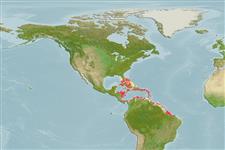
Récifal; profondeur 0 - 20 m (Réf. 83938). Tropical; 37°N - 8°S, 90°W - 37°W (Réf. 275)
Western Atlantic: southeast USA, southeast Gulf of Mexico, Bahamas, Caribbean island chain and northern South America.
Longueur à la première maturité / Taille / Poids / Âge
Maturité: Lm ? range ? - ? cm Max length : 100.0 cm TL mâle / non sexé; (Réf. 275); common length : 40.0 cm ML mâle / non sexé; (Réf. 3722); poids max. publié: 1.5 kg (Réf. 275)
Maximum total length is 60 cm in warmer parts of its distributional range (Ref. 275). This is a benthic species found in coral reefs, seagrass, rubble, and sandy bottoms in intertidal and subtidal areas (Ref. 83938).
Cycle de vie et comportement reproducteur
Maturité | Reproduction | Frai | Œufs | Fécondité | Larves
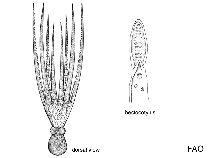
Members of the class Cephalopoda are gonochoric. Male and female adults usually die shortly after spawning and brooding, respectively. Mating behavior: Males perform various displays to attract potential females for copulation. During copulation, male grasp the female and inserts the hectocotylus into the female's mantle cavity where fertilization usually occurs. Life cycle: Embryos hatch into planktonic stage and live for some time before they grow larger and take up a benthic existence as adults.
Roper, C.F.E., M.J. Sweeney and C.E. Nauen 1984 FAO Species Catalogue. Vol. 3. Cephalopods of the world. An annotated and illustrated catalogue of species of interest to fisheries. FAO Fish. Synop. 125(3):277p. Rome: FAO. (Réf. 275)
Statut dans la liste rouge de l'IUCN
(Réf. 130435: Version 2025-2 (Global))
statut CITES (Réf. 108899)
Not Evaluated
Not Evaluated
Menace pour l'homme
Utilisations par l'homme
Pêcheries: commercial
FAO - Publication: search | FishSource |
Outils
Plus d'informations
Dynamique des populationsCroissanceÂges / tailles maximalesLongueur-poids rel.Rel. longueur-longueur.Fréquences de longueursConversion de masseAbondance Cycle de vieReproductionMaturitéFéconditéFraiŒufsDéveloppement de l'œufLarves PhysiologieConsommation d'oxygène
Liées à l'hommeTimbres, pièces de monnaie, divers
Sources Internet
Estimations basées sur des modèles
Vulnérabilité de la pêche
(Réf. 71543) |
High vulnerability (60 of 100). |
Catégorie de prix
(Réf. 80766): |
Low. |