Cephalopoda |
Oegopsida |
Brachioteuthidae
Môi trường: môi trường / vùng khí hậu / Mức độ sâu / phạm vi phân phối
Sinh thái học
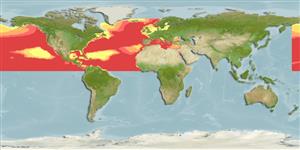
Pelagic-oceanic; mức độ sâu 0 - 3000 m (Tài liệu tham khảo 275). Subtropical; 68°N - 5°N, 170°E - 36°E
Worldwide. Tropical to polar.
Chiều dài lúc trưởng thành đầu tiên / Bộ gần gũi / Khối lượng (Trọng lượng) / Tuổi
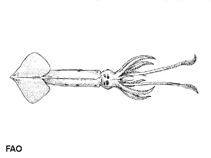
Chín muồi sinh dục: Lm ? range ? - ? cm Max length : 17.0 cm ML con đực/không giới tính; (Tài liệu tham khảo 97142)
Oceanic; occurs from near the surface through midwaters, the continental slope, to 3 000 m depth. Spawning season appears to be considerably extended with regard to the cosmopolitan distribution of the species complex. Consequently, recently hatched paralarvae and juveniles are found in epipelagic waters throughout the year. In the North Atlantic, paralarvae are particularly abundant from May to August and in February; in the Mediterranean and in upwelling areas off northwestern Africa between 10°N and 30°N, from April to July, September, and from December to February.
Paralarvae and juveniles are epipelagic to mesopelagic, then undergo ontogenetic descent to mesopelagic and bathypelagic zones as adults. In the western Atlantic (approximately 39°N 72°W) paralarvae, juveniles and subadults were captured in slope
and eddy water masses at 43 to 750 m, with paralarvae and juveniles at less than 300 m and adults greater than 300 m; diurnal vertical migration was indicated. Off Hawaii specimens were caught in closing nets at 830 to 975 m during day and 100 to 150 m
at night; open net captures were made at 975 to 1 000 m in daytime and at 50 and 250 m at night. Likewise, in the Mediterranean Sea specimens were caught in closing nets at 150 m during night time, and at 540 to 615 m by trawl nets during the day. Horizontal plankton net sampling at 100 m, 350 m and 650 m during sunrise, noon, sunset and midnight yielded a preponderance of juvenile B. riisei at 350 m. Frequent prey of sperm whales, striped dolphins, swordfish (Xiphias gladius) in Azorean waters, and giant red shrimp (Aristaeomorpha foliacea) in the Strait of Sicily, Mediterranean Sea. Known to prey on krill in Antarctic seas (Ref. 97142).
Vòng đời và hành vi giao phối
Chín muồi sinh dục | Sự tái sinh sản | Đẻ trứng | Các trứng | Sự sinh sản | Ấu trùng
Members of the class Cephalopoda are gonochoric. Male and female adults usually die shortly after spawning and brooding, respectively. Mating behavior: Males perform various displays to attract potential females for copulation. During copulation, male grasp the female and inserts the hectocotylus into the female's mantle cavity where fertilization usually occurs. Life cycle: Embryos hatch into planktonic stage and live for some time before they grow larger and take up a benthic existence as adults.
Roper, C.F.E., M.J. Sweeney and C.E. Nauen 1984 FAO Species Catalogue. Vol. 3. Cephalopods of the world. An annotated and illustrated catalogue of species of interest to fisheries. FAO Fish. Synop. 125(3):277p. Rome: FAO. (Tài liệu tham khảo 275)
Tình trạng Sách đỏ IUCN
(Tài liệu tham khảo 130435: Version 2025-2 (Global))
tình trạng CITES (Tài liệu tham khảo 108899)
Not Evaluated
CMS (Tài liệu tham khảo 116361)
Not Evaluated
Mối đe dọa đối với con người
Sử dụng của con người
FAO - Publication: search | FishSource |
Các công cụ
Thêm thông tin
Vòng đờiSự tái sinh sảnChín muồi sinh dụcSự sinh sảnĐẻ trứngCác trứngSự phát triển của trứngẤu trùng Sinh lý họcThành phần ô-xy
Liên quan đến con ngườiTem, tiền xu, v.v.
Các nguồn internet
Ước tính dựa trên mô hình
Sự dễ bị tổn thương của nghề đánh cá
(Tài liệu tham khảo 71543) |
Low vulnerability (10 of 100). |
Loại giá
(Tài liệu tham khảo 80766): |
Medium. |