Cephalopoda |
Octopoda |
Octopodidae | Octopodinae
पर्यावरण: पर्यावरण / जलवायु क्षेत्र / गहराई सीमा / वितरण सीमा
पारिस्थितिकी
Benthic; गहराई सीमा 0 - 190 m (संदर्भ 96968). Temperate
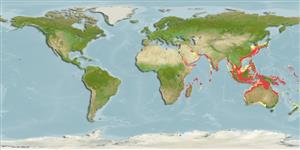
Indo-West Pacific.
प्रथम परिपक्वता पर लंबाई / आकार / वज़न / आयु
परिपक्व अवधि: Lm ? range ? - ? cm Max length : 30.0 cm TL पुल्लिंग / अलिंग; (संदर्भ 96968); अधिकतम प्रकाशित वज़न: 400.00 g (संदर्भ 96968)
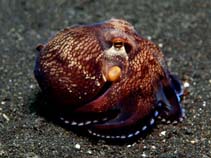
Has a color pattern of a dark brown to purple longitudinal stripe along the dorsal faces of at least arms I to III. Dark purple angular reticulations are also present on the lateral arm crown, with contrastring pink to white suckers. Papillae are dense, some of which coalesce into longitudinal bars on the lateral mantle.
Its mantle length is 10 cm (Ref. 96968). Found from shallow subtidal to at least 190 meters. Known from coastal muddy waters on mud and substrates. Feeds on crustaceans like crabs Calappa sp., and bivalves. It makes dens in clamshells, coconut shells, bottles and other man-made discarded objects in sand and mud. It will carry one mollusk shell or half a coconut shell while searching for another shell in which to enclose itself (Ref. 96968).
जीवन चक्र और संभोग व्यवहार
परिपक्व अवधि | पुनरुत्पत्ति | मछलीऔ का अंडे देना | अंडे | उपजाऊपन | लार्वा
Members of the class Cephalopoda are gonochoric. Male and female adults usually die shortly after spawning and brooding, respectively. Mating behavior: Males perform various displays to attract potential females for copulation. During copulation, male grasp the female and inserts the hectocotylus into the female's mantle cavity where fertilization usually occurs. Life cycle: Embryos hatch into planktonic stage and live for some time before they grow larger and take up a benthic existence as adults.
Norman, M.D. and C.C. Lu 2000 Preliminary checklist of the cephalopods of the South China Sea. The Raffles Bulletin of Zoology 8:539-567. (संदर्भ 81752)
आईयूसीएन रेड लिस्ट स्थिति
(संदर्भ 130435: Version 2025-2 (Global))
CITES स्थिति (संदर्भ 108899)
Not Evaluated
CMS (संदर्भ 116361)
Not Evaluated
मनुष्यों के लिए ख़तरा
मानव उपयोग
मात्स्यिकी: व्यापारिक
FAO - Publication: search | FishSource |
साधन
अधिक जानकारी
जनसंख्या गतिशीलताबाढ़
अधिकतम आयु/आकार
लंबाई-वजन संबंध
लंबाई-लंबाई संबंध
लंबाई-आवृत्तियाँ
सामूहिक रूपांतरण
बहुतायत
जीवन चक्रपुनरुत्पत्तिपरिपक्व अवधिउपजाऊपनमछलीऔ का अंडे देनाअंडेअंडे का विकासलार्वा फिजियोलॉजीप्राणवायु की खपत
मानव संबंधीटिकट, सिक्के, विविध.
इंटरनेट स्रोत
मॉडल पर आधारित अनुमान
मछली पकड़ने की भेद्यता
(संदर्भ 71543) |
Low vulnerability (20 of 100). |
मूल्य श्रेणी
(संदर्भ 80766): |
Low. |