Cephalopoda |
Sepiida |
Sepiidae
Περιβάλλον: περιβάλλον / κλιματική ζώνη / εύρος βάθους / εύρος διανομής
Οικολογία
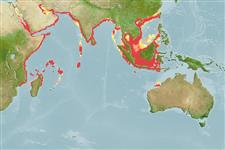
Benthic; εύρος βάθους 9 - 160 m (Αναφ. 103583). Tropical; 31°N - 19°S, 32°E - 121°E (Αναφ. 1695)
Indo-West Pacific: from Indian Ocean to Indonesia and southern South China Sea.
Μήκος κατά την πρώτη ωρίμανση / Μέγεθος / Βάρος / Ηλικία
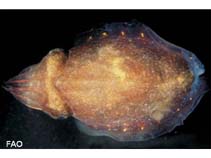
Γεννητική Ωρίμανση: Lm 6.1 range ? - ? cm Max length : 12.5 cm ML αρσενικό/απροσδιόριστο; (Αναφ. 275)
Females grow larger than males (Ref. 3722). Feeds on small demersal fishes, crustaceans, other cephalopods (Ref. 275).
Members of the class Cephalopoda are gonochoric. Male and female adults usually die shortly after spawning and brooding, respectively. Mating behavior: Males perform various displays to attract potential females for copulation. During copulation, male grasp the female and inserts the hectocotylus into the female's mantle cavity where fertilization usually occurs. Life cycle: Embryos hatch into planktonic stage and live for some time before they grow larger and take up a benthic existence as adults.
Jereb, P. and C.F.E. Roper (eds.) 2005 Cephalopods of the world. An Annotated and Illustrated catalogue of Cephalopod species known to date. Vol. 1. Chambered nautiluses and sepioids (Nautilidae, Sepiidae, Sepiolidae, Sepiadariidae, Idiosepiidae and Spirulidae). FAO Spec. Cat. Fish. Purp. 4(1):262p. Rome: FAO. (Αναφ. 1695)
Κατάσταση Κόκκινου Καταλόγου IUCN
(Αναφ. 130435: Version 2025-2 (Global))
Καθεστώς CITES (Αναφ. 108899)
Not Evaluated
Not Evaluated
Απειλή για τον άνθρωπο
Ανθρώπινες χρήσεις
αλιεία: Εμπορικό(ά)
FAO - Publication: search | FishSource |
Εργαλεία
Περισσότερες πληροφορίες
ΦυσιολογίαΚατανάλωση οξυγόνου
Ανθρώπινη σχέσηΓραμματόσημα, νομίσματα, διάφορα.
Διαδικτυακές πηγές
Εκτιμήσεις βάσει μοντέλων
Ελαστικότητα
(Ref. 69278): |
Υψηλό, ελάχιστος χρόνος για διπλασιασμό πληθυσμού < 15 μήνες (K=0.52-2.25) |
Ευπάθεια στην αλιεία
(Αναφ. 71543) |
Low vulnerability (10 of 100). |
Κατηγορία τιμής
(Αναφ. 80766): |
High. |