Cephalopoda |
Sepiida |
Sepiidae
Umwelt: Milieu / Klimazone / Tiefenbereich / Verbreitungsgebiet
Ökologie
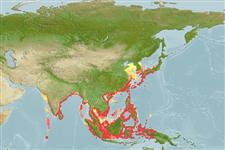
Benthic; tiefenbereich 0 - 60 m (Ref. 275), usually 5 - 20 m (Ref. 275). Tropical; 41°N - 6°S, 69°E - 138°E (Ref. 1695)
Indo-West Pacific: Southern India to Japan and the Philippines.
Länge bei der ersten Reifung / Größe / Gewicht / Alter
Geschlechtsreife: Lm 9.5, range 10 - 12 cm Max length : 23.0 cm ML Männchen/unbestimmt; (Ref. 275); max. veröff. Gewicht: 1.3 kg (Ref. 1695)
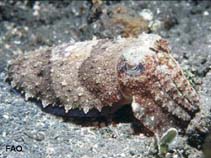
Mantle about half as broad as long; tentacular club long, slender with 10-12 minute, subequal suckers in each row across the club in males, 13-14 suckers across in females, club protective membranes not united, extending proximally along oral face of stalk as lo ridges, Left arm IV hectocotylized: about 12 normal suckers (3 series) proximally followed by about 5 or 6 series of very small suckers in ventral longitudinal rows, corresponding suckers of dorsal longitudinal rows extremely minute (or absent) in a deep, smooth groove, suckers normal distally, Color: dorsal mantle with a fine, dark-pigmented, transverse, reticulate color pattern, a pale reflective line along bases of fins (Ref. 275).
Usually caught using otter trawls. Pair trawls are used for offshore fishing and smaller catches and to a lesser extent, squid light-lures and traps. Push nets and lift nets are used for inshore and coastal fishing (Ref. 346). Commercially caught from Gulf of Thailand and Andaman Sea (Ref. 1695). Occurs from shore down to 60 m (Ref. 275).
Members of the class Cephalopoda are gonochoric. Male and female adults usually die shortly after spawning and brooding, respectively. Mating behavior: Males perform various displays to attract potential females for copulation. During copulation, male grasp the female and inserts the hectocotylus into the female's mantle cavity where fertilization usually occurs. Life cycle: Embryos hatch into planktonic stage and live for some time before they grow larger and take up a benthic existence as adults.
Jereb, P. and C.F.E. Roper (eds.) 2005 Cephalopods of the world. An Annotated and Illustrated catalogue of Cephalopod species known to date. Vol. 1. Chambered nautiluses and sepioids (Nautilidae, Sepiidae, Sepiolidae, Sepiadariidae, Idiosepiidae and Spirulidae). FAO Spec. Cat. Fish. Purp. 4(1):262p. Rome: FAO. (Ref. 1695)
IUCN Rote Liste Status
(Ref. 130435: Version 2025-2 (Global))
CITES Status (Ref. 108899)
Not Evaluated
Not Evaluated
Bedrohung für Menschen
Nutzung durch Menschen
Fischereien: kommerziell
FAO - Publication: search | FishSource |
Tools
Mehr Information
PhysiologieSauerstoffverbrauch
MenschenbezogenBriefmarken, Münzen, Verschiedenes.
Internet Quellen
Schätzungen auf der Grundlage von Modellen
Widerstandsfähigkeit
(Ref. 69278): |
hoch, Verdopplung der Population dauert weniger als 15 Monate. (K=0.4-1.49) |
Anfälligkeit der Fischerei
(Ref. 71543) |
Low vulnerability (12 of 100). |
Preiskategorie
(Ref. 80766): |
High. |