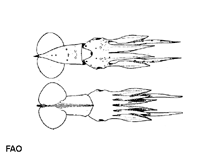
Cephalopoda |
Oegopsida |
Pyroteuthidae
Ambiente: milieu / zona climática / intervalo de profundidade / gama de distribuição
Ecologia
Batipelágico; intervalo de profundidade 50 - 800 m (Ref. 97142). Subtropical; 68°N - 54°S, 180°W - 180°E (Ref. 97142)
Atlantic Ocean, Indo-West Pacific and the Mediterranean Sea. Tropical to temperate.
Comprimento na primeira maturidade / Tamanho / Peso / Idade
Maturidade: Lm ? range ? - ? cm Max length : 5.0 cm ML macho/indeterminado; (Ref. 97142)
Cosmopolitan in tropical, subtropical to temperate waters. In the South Pacific Ocean the species is common in the mixed waters of the subtropical frontal zone and the sub-Antarctic waters. Adults occupy the upper mesopelagic zone during the day and
then undergo diel vertical migration into epipelagic waters at night: off Bermuda, closing-net studies showed it occurs principally at 375 to 500 m during the day and
ascends to 75 to 175 m at night; in open net studies off the Canary Islands, found them at 400 to 800 m during the day and 50 to 100 m to 200 m at night. The species occurs in the eastern Mediterranean Sea/northern Aegean Sea in the mesobathyal basins (Ref. 97142).
Ciclo de vida e comportamento de acasalamento
Maturidade | Reprodução | Desova | Ovos | Fecundidade | Larvas
Members of the class Cephalopoda are gonochoric. Male and female adults usually die shortly after spawning and brooding, respectively. Mating behavior: Males perform various displays to attract potential females for copulation. During copulation, male grasp the female and inserts the hectocotylus into the female's mantle cavity where fertilization usually occurs. Life cycle: Embryos hatch into planktonic stage and live for some time before they grow larger and take up a benthic existence as adults.
Turgeon, D.D., J.F. Quinn Jr., A.E. Bogan, E.V. Coan, F.G. Hochberg, W.G. Lyons, P.M. Mikkelsen, R.J. Neves, C.F.E. Roper, G. Rosenberg, B. Roth, A. Scheltema, F.G. Thompson, M. Vecchione and J.D. Willams 1998 Common and scientific names of aquatic invertebrates from the United States and Canada: Mollusks, 2nd ed. American Fisheries Society (Special publication 26), Bethesda, Maryland. 526 p. (Ref. 1667)
Categoria na Lista Vermelha da IUCN
(Ref. 130435: Version 2025-2 (Global))
Categoria CITES (Ref. 108899)
Not Evaluated
Not Evaluated
Ameaça para o homem
Utilização humana
FAO - Publication: search | FishSource |
Ferramentas
Mais informação
Dinâmica das populaçõesCrescimentoIdades / tamanhos máximosComprimento-peso rel.Comprimento-comprimento rel.Frequência de comprimentoConversão de massaAbundância Ciclo de vidaReproduçãoMaturidadeFecundidadeDesovaOvosDesenvolvimento dos ovosLarvas FisiologiaConsumo de oxigénio
Relacionado com o ser humanoSelos, moedas, diversos.
Fontes da internet
Estimativas baseadas em modelos
Vulnerabilidade da pesca
(Ref. 71543) |
Low vulnerability (10 of 100). |
Categoria de preço
(Ref. 80766): |
Medium. |