Cephalopoda |
Oegopsida |
Enoploteuthidae
Ambiente: milieu / zona climatica / distribuzione batimetrica / gamma di distribuzione
Ecologia
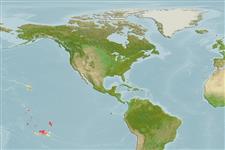
Pelagico; distribuzione batimetrica 20 - 576 m (Fonte Biblio. 97332). Tropical; 22°N - 28°S, 160°W - 133°W (Fonte Biblio. 3729)
Central equatorial Pacific Ocean; from 16°N to 15°S and from 144°W to 168°W (Ref. 3729).
Lunghezza alla prima maturità / Dimensione / Peso / Età
Maturità: Lm 5.0 range ? - ? cm Max length : 4.0 cm ML maschio/sesso non determinato; (Fonte Biblio. 97142)
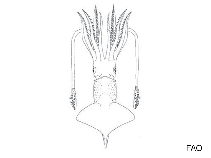
Fins long and wide. Lozenge-shaped translucent area between fins at posterior middorsal tip present in newly preserved specimens only. Head narrower than mantle width. Dorsal and ventral "windows" extensive and thin. Buccal membrane rugose near free edge, papillose
toward oral opening. Large purplish chromatophores scattered on outer surface of supports and membrane. Arms moderate, slender, with fine delicate tips. Most common arm formula 4.2.3.1. Left arm IV of males hectocotylized, devoid of distal suckers in adult stage. Biserial arm hooks triangular, apertures fused. Largest hooks on arm I, smallest on arm IV. Number of hooks on each arm fairly constant (13-17 on arms I-III, 18-21 on arm IV), fewer on hectocotylus. Except hectocotylus, distal third of arms with biserial suckers. Proximal suckers on long stalks, openings round, 6 truncate teeth on distal margin of inner ring and a narrow inner shelf, progressively globular toward tip. Globular suckers absent on arms IV. Total sucker counts 30-56 on arms I, II and III and 20-25 on arm IV. Tentacles long; club short, slender. Carpal cluster; 3-5 suckers and pads in rectangular to oval outline. Manus: 8-10 long-stalked suckers in 2 rows dorsally, 2-4 medium sized hooks on one row ventrally. Hooks with short wide base; shaft long, laterally compressed, curved and pointed. Manal suckers with about 22 pointed teeth around margin of inner ring and long !pegson outer ring. Dactylus: 17-22 quadriserial sucker rows. Thin ventral semilunar flap between carpus and third hook. Protective membrane on both sides, in form of undulating membrane on dorsal side opposite manal suckers. Photophores and their distribution pattern closely resembles that of A. trigonura, except for the narrow space around the large white photophores and different position on arm III and vesiculate tail. Arm III with a dorsal row of 6-8 widely spaced light organs on basal third of arm and a ventral row along base of swimming keel; the latter with 2 light organs proximally followed by a considerable gap, then a series of 6-8 widely spaced photophores distally. Five-eye light-organs: posterior organ largest (3 mm long), oval, dull pink; with a very small round organ (0.5 mm) adjacent. Anterior 3 organs small (1.0, 0.75, 1.2 mm), evenly spaced; anteriormost organ more elliptical than others. Mandibles with small notch on upper corner of wing. Gladius with prominent sharp keel. Vanes thin, slightly thickened at free edge, origin at about 2/3 of GL, anterior margin straight, posterior margin convex, lateral blunt angles at midlevel of GL. Conus blunt and shallow. Ink sac long, duct with bulb-like swelling before entry into rectum. Sperm reservoirs deposited on posterior half of nuchal cartilage and inner dorsal midline near gladius tip. Attachment area very rugose, not sac-like, only anterior half of nuchal cartilage visible. Freshly preserved females with elongated pigmented spot at anterior dorsal side of mantle. Eggs spherical, about 1.25 mm diameter in largest female. Oviducal glands large, protrude out of mantle in gravid females. Spermatophore: total length 4.0 mm; sperm reservoir length 1.8 mm; cement gland length 1.0 mm, with conspicuous ambercolored swelling at oral end; spiral filament length 1.2 mm, with 2-3 coils near oral end, filament without sculpturing.
Maximum depth from Ref. 3729.
Ciclo vitale e comportamento di accoppiamento
Maturità | Riproduzione | Deposizione | Uova | Fecondità | Larve
Enoploteuthid squids spawn individual eggs into the plankton and produce 10,000 to 20,000 eggs.
Wood, J.B. and C.L. Day 1998 CephBase. http://www.cephbase.utmb.edu/. [Accessed 26/01/06]. (Fonte Biblio. 3722)
Stato della Lista Rossa IUCN
(Fonte Biblio. 130435: Version 2025-2 (Global))
Stato della CITES (Fonte Biblio. 108899)
Not Evaluated
CMS (Fonte Biblio. 116361)
Not Evaluated
Minaccia per l'uomo
Usi umani
FAO - Publication: search | FishSource |
Strumenti
Informazioni ulteriori
Dinamica della popolazioneAccrescimento
Età massima / dimensioni massime
Rapporto lunghezza-peso.
Lunghezza-lunghezza rel.
Lunghezza-frequenze
Conversione di massa
Abbondanza
FisiologiaConsumo di ossigeno
Legato all'uomoFrancobolli, monete, materiale vario.
Fonti Internet
Stime basate su modelli
Vulnerabilità della pesca
(Fonte Biblio. 71543) |
Low vulnerability (10 of 100). |
Categoria di prezzo
(Fonte Biblio. 80766): |
Medium. |