Cephalopoda |
Oegopsida |
Enoploteuthidae
Miljö: miljö / Klimatzon / djupintervall / distributionsområde
Ekologi
Pelagiska. Tropical
Eastern Central Pacific: Endemic to Hawaii.
Längd vid första mognad / Storlek / Vikt / Ålder
Könsmognad: Lm ? range ? - ? cm Max length : 4.0 cm ML hane/ej könsbestämd; (Ref. 3729)
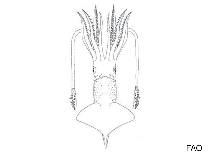
Funnel organ: dorsal pad inverted V, limbs broad with small pointed papilla, lateral ridges low; ventral pad oval, produced anteriorly. Each arms with 9-15 hooks and a series of suckers on distal third of arm. Hooks: base triangular, tip curved. Proximal third of arm suckers on long stalks, about 20-22 teeth around margin of inner ring (6 or more broad teeth on distal margin), shelf behind inner ring proximally with notch, several rows of pegs on outer ring; distal suckers globular, small aperture. Arm suckers biserial, may appear arranged in three rows in some arms. Arm IV generally lacks globular suckers; rarely with 2 or 3 following regular sucker rows. Left arm IV of male hectocotylized; ventral semicircular lappet and smaller
dorsal lappet present. Both lappets thick and tend to stay folded medially. Distal suckers absent. Tentacles long. Club not expanded. Carpal cluster oval in outline, with 3-5 smooth-ringed suckers. Manus with 2-4 ventral hooks, 6-8 dorsal suckers in 2 rows. Manal suckers on long stalks, about 30 blunt teeth on inner ring, small pegs on outer ring. Dactyl suckers quadriserial (17-20 rows), few irregular teeth on inner ring margin. A ventral flap from distal portion of carpal cluster to opposite second hook. Dorsal protective membrane extends from 1st club sucker to 1st row of dactyl suckers, much narrower anteriorly. Integumentary photophores numerous; larger white ones with dark edge and smaller, darker ones of varying sizes. Photophores most numerous on ventral side of mantle, fewer toward dorsal side, few on fin surface, 3-4 on margins of vesiculate tail, none on median ventral area. On mantle ventrally, white photophores set widely apart (antero-posterior rows), smaller dark photophores scattered around and between white ones. Ventral side of funnel with 2 broad strips (narrow median space present), short strip on each side, single white photophore in each strip. Cluster of photophores close to bridles. On head ventrally a broad band of photophores (8-10 white surrounded by smaller dark organs) extends from funnel groove area, 1st and 2nd nuchal folds, to base of arms IV. Within funnel groove 2-3 isolated organs on each side present, small triangular space in front of bridles. Semicircular row extends from near 3rd nuchal fold, spreads laterally and medially to base of arm IV. Few small light organs between semicircular row and eyelid. Arm IV photophores: a row on aboral edge; another along base of tentacular sheath (white photophores distributed regularly in these rows); third row, small ones at edge of tentacular sheath, ends at 3/4 of arm length. Arm III: one white
photophore near proximal end of keel, about 6 evenly-spaced small light organs deeply embedded in base of keel; 2 or 3 small photophores on dorsal side near arm base. Arm II: one small light organ at arm base. Arm I: no light organs. Five eye light organs: 2 large oval dull pink terminal organs (posterior organ 3 times size of anterior), 3 much smaller round amber-colored organs between them (middle organ slightly larger). First and third round organs usually adjacent to end organs. Gladius, with strong rachis, pointed anteriorly. Keel rounded dorsally on anterior third of gladius length (GL), a sharp ridge posteriorly. Vane length about 70% of GL, total width about 25% of GL, margins slightly concave demarcated
by rounded angle. Conus small and broadly rounded. Mandibles typical enoploteuthid with three supporting ribs on gular plate of lower mandible. Spermatophores small (7.0 mm total length), slender (0.25 mm). Spiral filament 2.1 mm long, 2-3 coils behind cap. Cement gland cylindrical, 0.9 mm long. Sperm reservoir 4 mm long. Spermatophores deposited in sac-like seminal receptacle posterior to nuchal cartilage between stellate ganglia. Pigmented
round spot on middorsal line of mantle indicates presence of sac below (in freshly preserved squids only). Ink sac slender, duct with bulb-like expansion before entry into rectum.
Livscykel och parningsbeteende
Könsmognad | Reproduktion | Lek | Ägg | Fekunditet | Larver
Members of the class Cephalopoda are gonochoric. Male and female adults usually die shortly after spawning and brooding, respectively. Mating behavior: Males perform various displays to attract potential females for copulation. During copulation, male grasp the female and inserts the hectocotylus into the female's mantle cavity where fertilization usually occurs. Life cycle: Embryos hatch into planktonic stage and live for some time before they grow larger and take up a benthic existence as adults.
Wood, J.B. and C.L. Day 1998 CephBase. http://www.cephbase.utmb.edu/. [Accessed 26/01/06]. (Ref. 3722)
Status på IUCN:s rödlista
(Ref. 130435: Version 2025-2 (Global))
CITES-status (Ref. 108899)
Not Evaluated
Not Evaluated
Hot mot människor
Mänskliga användningsområden
FAO - Publication: search | FishSource |
Verktyg
Ytterligare information
Trofisk ekologiLivsmedelsartiklar (preys)FödosammansättningFödointagPredatorer PopulationsdynamikTillväxt
Max. åldrar / storlekar
Längd-vikt rel.
Längd-längd rel.
Längd-frekvenser
Massakonvertering
Abundans
LivscykelReproduktionKönsmognadFekunditetLekÄggUtveckling av äggLarver MänniskorelateradFrimärken, mynt, diverse.
Internet-källor
Uppskattningar baserade på modeller
Sårbarhet i fisket
(Ref. 71543) |
Low vulnerability (10 of 100). |
Priskategori
(Ref. 80766): |
Medium. |