Cephalopoda |
Oegopsida |
Enoploteuthidae
Environnement : milieu / zone climatique / profondeur / gamme de distribution
Écologie
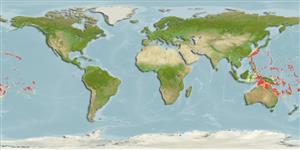
Pelagic-oceanic; profondeur 7 - 650 m (Réf. 97333). Tropical; 31°N - 27°S, 117°E - 138°W
Pacific Ocean.
Longueur à la première maturité / Taille / Poids / Âge
Maturité: Lm 5.0 range ? - ? cm Max length : 4.0 cm ML mâle / non sexé; (Réf. 2446)
Description synthétique
Morphologie
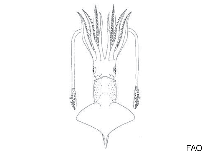
Mantle, cylindrical, widest in mid-region, tapering with concave outline to a blunt point; margin slightly produced in mid-region dorsally, excavated ventrally, with sharp lateral angles beneath funnel. Fins short, wide, anterior lobes free, anterior margin convex, posterior margin slightly concave, posterior point not drawn out in long tail. Funnel large, mostly projecting; locking apparatus straight, simple; funnel organ V shaped, double shouldered, with apical papilla and short ridge crossing anterior shoulder, ventral pads boomerang shaped with concave inner margins; funnel valve, broad, subterminal. Head small, compact, about as wide as mantle, with small, prominent eyes; ventral surface excavated for funnel; eyelids nearly round with small distinct anterior sinus; four nucha. l folds of which second from midline is olfactory crest, two ventral pads luncate, lateral and dorsal folds long, united by transverse ridge. Arms strong, medium size, order 4.3 = 2.1; trabeculate protective membranes on all arms, ventral deepest; I keeled on entire length, II on distal half, III deeply keeled on entire length, IV with wide sheath. I bears 17 hooks, 12 large suckers with about 18 long blunt teeth on distal margin, 19 pairs of minute ringless suckers; II bears 18 hooks, 14 large suckers and 19 pairs of minute suckers; III bears 16 hooks, 14 large and 10 minute suckers (tips of both arms partly missing); arm IV bears 19 hooks and 10 pairs of large suckers regularly increasing in size to the tip of the arm. Tentacles short, square in cross-section with small, slightly expanded clubs; carpal cluster distinct, composed of 5 cups and 4 pads on each tentacle; manus equipped with ventral rows of 5 hooks, proximal minute, third largest; two rows of large suckers bordering hooks bearing about 30 triangular teeth, four rows of small suckers in dactylus regularly decreasing to tip. Ventral edge of club bordered by a semilunar protective membrane originating at carpus and ending near fourth hook, but extending to tip as low fold; dorsal edge with low membrane originating from carpus and extending to tip, broadest proximally, deep keel on distal three fourths of aboral surface. Photophores of three types: 1) small and clear, 2) medium in size and dark, 3) large and clear with dark ring. Mantle with about 8 rows of large light organs on ventral surface, accompanied by small light organs not so distinctly in series, with many intervening ones; light clear streak on ventral midline, widely scattered but numerous medium light organs on dorsal surface of mantle and between fins. In addition, there are, near the posterior end of the mantle and adjacent to the fins, two large, yellowish biscuit-shaped bodies which may be photogenic. They can be found by running a probe along the side of the mantle and then rupturing the skin over them. They are homologous with the similar bodies found in A. astrolineata Berry, 1914b. Ventral surface of funnel with four large organs in transverse row midway between mantle margin and tip, remaining photophores grouped symmetrically in two triangular patches. Light organs on ventral surface of head in 5 distinct, widely spaced rows with narrow circlet about each eyelid; dorsal surface of head with 4 organs forming a diamond in mid section. Arms with light organs in regular pattern. I and II with 3-6 small light organs distributed from base outward; III with 5-6 light organs in ventral side of keel; IV with 3 rows of mixed light organs, ventral row formed on each side by bifurcation of median row of head, extending nearly to tip of arm, first lateral row of head on each side forms median row of IV, extending to extreme tip consisting 3 minute light organs, second lateral row of head on either side forms dorsal row of IV which ends posterior to tip. Four large, deeply buried, lens like brownish bodies, not seen except by strong light through arm are found near tip and presumably are light organs. Ventral periphery of eyeball with 5 round, equal size light organs, terminal ones slightly separate from crowded middle ones, all dark brown, terminal organs slightly lighter. Numerous oval eggs, 1.0 mm by 0.6 mm, closely packed in ovary.
Minimum depth from Ref. 3729. A widely distributed tropical, subtropical species of the mesopelagic-boundary fauna (Ref. 97142). Adults are nektonic and paralarva are planktonic (Ref. 97336). Paralarva measures 14 mm ML at maximum and present at depths of 300-400 m (Ref. 98072).
Cycle de vie et comportement reproducteur
Maturité | Reproduction | Frai | Œufs | Fécondité | Larves
Enoploteuthid squids spawn individual eggs into the plankton and produce 10,000 to 20,000 eggs.
Wood, J.B. and C.L. Day 1998 CephBase. http://www.cephbase.utmb.edu/. [Accessed 26/01/06]. (Réf. 3722)
Statut dans la liste rouge de l'IUCN
(Réf. 130435: Version 2025-2 (Global))
statut CITES (Réf. 108899)
Not Evaluated
Not Evaluated
Menace pour l'homme
Utilisations par l'homme
FAO - Publication: search | FishSource |
Outils
Plus d'informations
Dynamique des populationsCroissance
Âges / tailles maximales
Longueur-poids rel.
Rel. longueur-longueur.
Fréquences de longueurs
Conversion de masse
Abondance
PhysiologieConsommation d'oxygène
Liées à l'hommeTimbres, pièces de monnaie, divers
Sources Internet
Estimations basées sur des modèles
Vulnérabilité de la pêche
(Réf. 71543) |
Low vulnerability (10 of 100). |
Catégorie de prix
(Réf. 80766): |
Medium. |