Cephalopoda |
Myopsida |
Loliginidae
Milieu: milieu / Klimaatzone / Diepte / verspreidingsgebied
Ecologie
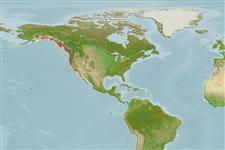
Pelagisch; diepte 15 - 1000 m (Ref. 138479). Tropical, preferred 13°C (Ref. 107945); 62°N - 26°N, 172°W - 112°W (Ref. 112699)
Eastern Pacific. Tropical to boreal.
Lengte bij maturiteit / Grootte / Gewicht / Leeftijd
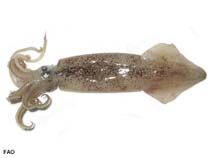
Maturiteit: Lm ? range ? - ? cm Max length : 19.2 cm ML mannelijk / geslacht onbekend; (Ref. 94063); 17.9 cm ML (female); max. gepubliceerd gewicht: 148.00 g (Ref. 94063); max. gepubliceerd gewicht: 148.00 g
Caught by brails and night lights and pumps and night lights. Individual behavior: pale coloration indicates relaxation while dark, high contrast chromatic elements indicate alertness; protracted inking occurs after an abrupt stop from a backward jetting squid; in swimming, drag is reduced from the tightening of fin curvature which reduces the fin span relative to the average fin chord; fins and arms were used to maneuver. Schooling and shoaling: schools at night were tighter than during the day (Ref. 94861).
Levenscyclus en paargedrag
Maturiteit | Voortplanting | Paaien | Eieren | Fecunditeit | Larven
Mating and egg-laying occur at daylight (Refs. 94843, 94849), egg beds found at depths of 20-60 m (Ref. 94843).
Roper, C.F.E., M.J. Sweeney and C.E. Nauen 1984 FAO Species Catalogue. Vol. 3. Cephalopods of the world. An annotated and illustrated catalogue of species of interest to fisheries. FAO Fish. Synop. 125(3):277p. Rome: FAO. (Ref. 275)
Status op de Rode Lijst van het IUCN
(Ref. 130435: Version 2025-2 (Global))
CITES status (Ref. 108899)
Not Evaluated
Not Evaluated
Gevaar voor de mens
Gebruik door de mens
Visserij: commercieel
FAO - visserij: landings search; Publication: search | FishSource | Sea Around Us
Tools
Meer informatie
FysiologieZuurstofverbruik
Menselijk gerelateerdPostzegels, munten, diversen.
Internetbronnen
Schattingen op basis van modellen
Weerstandsvermogen
(Ref. 69278): |
Hoog, minimale populatieverdubbelingstijd minder dan 15 maanden (K=1) |
Rate of population increase
|
Prior r = 0.93, 95% CL = 0.61 - 1.39, Based on 2 data-limited stock assessments. |
Kwetsbaarheid van de visserij
(Ref. 71543) |
Low vulnerability (10 of 100). |
Kwetsbaarheid voor het klimaat
(Ref. 125649) |
Low to moderate vulnerability (35 of 100) |
Prijsklasse
(Ref. 80766): |
Low. |
Nutrients
|
Calcium = 126 [75, 177] mg/100g; Iron = 4.79 [1.67, 7.92] mg/100g; Protein = 15.5 [13.7, 17.4] %; Omega3 = 0.414 [0.262, 0.566] g/100g; Selenium = 57.8 [48.5, 67.2] μg/100g; VitaminA = 0 μg/100g; Zinc = 1.97 [0.92, 3.02] mg/100g (wet weight); based on nutrient studies. |