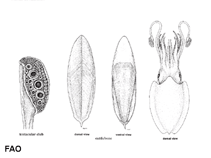
Cephalopoda |
Sepiida |
Sepiidae
पर्यावरण: पर्यावरण / जलवायु क्षेत्र / गहराई सीमा / वितरण सीमा
पारिस्थितिकी
ड़िमरसल; खारा; गहराई सीमा 15 - 570 m (संदर्भ 1695), usually 50 - 250 m (संदर्भ 1695). Subtropical; 55°N - 17°S, 22°W - 36°E (संदर्भ 107081)
Eastern Atlantic and the Mediterranean: from Irish Sea to southern Angola.
प्रथम परिपक्वता पर लंबाई / आकार / वज़न / आयु
परिपक्व अवधि: Lm 7.0, range 4 - ? cm Max length : 9.6 cm ML पुल्लिंग / अलिंग; (संदर्भ 1695); 12 cm ML (female)
Mantle length at first sexual maturity in West Africa: 4.0-5.0 cm (male); 7.0 cm. Mantle length at first sexual maturity in western Mediterranean: 5.0 cm (males); 7.8 cm (females; Ref. 275).
Inshore (Ref. 122891). A demersal (Ref. 1695), nektonic (Ref. 417), nektobenthic (Ref. 122890) species. Found over sandy and sandy-muddy bottoms (Ref. 1695) and detritus-rich continental shelf and slope (Ref. 417). In the Sea of Marmara, the species can occur in brackish waters. In Mediterranean waters, spawning period is likely continuous as males and females are usually found together throughout the year, with peaks in activity in spring and autumn. In Portuguese waters, predominance of mature individuals in spring is also reported. No record of onshore spawning migration. With the extended reproductive period, recruitment is also continuous but variable, with seasonal density peaks. Males mature at 6 or 7 months and females at 9 or 10 months. Eggs (7 to 8.5 mm maximum diameter and proportional to female size) are laid in clusters of 30 to 40 and are attached to sponges on muddy bottoms. Diet may consist of fish and cephalopods but mainly of crustaceans. One of the most abundant cephalopod species in some areas of the Mediterranean. Taken mainly as bycatch in trawl fisheries; marketed fresh and frozen along with S. elegans and small S. officinalis and constitutes a valuable resource locally. Intense fishing pressure on this resource is reported in the Sicilian Channel. Sympatric (and confused) with S. elegans Blainville, 1827 (Ref. 1695).
जीवन चक्र और संभोग व्यवहार
परिपक्व अवधि | पुनरुत्पत्ति | मछलीऔ का अंडे देना | अंडे | उपजाऊपन | लार्वा
Members of the class Cephalopoda are gonochoric. Male and female adults usually die shortly after spawning and brooding, respectively. Mating behavior: Males perform various displays to attract potential females for copulation. During copulation, male grasp the female and inserts the hectocotylus into the female's mantle cavity where fertilization usually occurs. Life cycle: Embryos hatch into planktonic stage and live for some time before they grow larger and take up a benthic existence as adults.
Jereb, P. and C.F.E. Roper (eds.) 2005 Cephalopods of the world. An Annotated and Illustrated catalogue of Cephalopod species known to date. Vol. 1. Chambered nautiluses and sepioids (Nautilidae, Sepiidae, Sepiolidae, Sepiadariidae, Idiosepiidae and Spirulidae). FAO Spec. Cat. Fish. Purp. 4(1):262p. Rome: FAO. (संदर्भ 1695)
आईयूसीएन रेड लिस्ट स्थिति
(संदर्भ 130435: Version 2025-2 (Global))
CITES स्थिति (संदर्भ 108899)
Not Evaluated
CMS (संदर्भ 116361)
Not Evaluated
मनुष्यों के लिए ख़तरा
मानव उपयोग
मात्स्यिकी: व्यापारिक
FAO - Publication: search | FishSource |
साधन
अधिक जानकारी
फिजियोलॉजीप्राणवायु की खपत
मानव संबंधीटिकट, सिक्के, विविध.
इंटरनेट स्रोत
मॉडल पर आधारित अनुमान
मछली पकड़ने की भेद्यता
(संदर्भ 71543) |
Low vulnerability (10 of 100). |
मूल्य श्रेणी
(संदर्भ 80766): |
High. |