Cephalopoda |
Oegopsida |
Gonatidae
Environnement : milieu / zone climatique / profondeur / gamme de distribution
Écologie
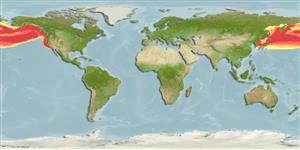
Bathypélagique; profondeur 0 - 1500 m (Réf. 275). Tropical; 71°N - 26°N, 125°E - 83°W
Northwest to Eastern Pacific. Tropical to polar climates.
Longueur à la première maturité / Taille / Poids / Âge
Maturité: Lm ? range ? - ? cm Max length : 28.0 cm ML mâle / non sexé; (Réf. 104302); âge max. reporté: 4 années (Réf. 104304)
Maximum depth from Ref. 104112. Occurs in the outer edge of continental shelf and slope. Juveniles are mostly in midwater at mesopelagic depths; adults mainly occur in bottom layers in the upper bathyal zone. Exhibits diel vertical migration (Ref. 104112).
Cycle de vie et comportement reproducteur
Maturité | Reproduction | Frai | Œufs | Fécondité | Larves
Members of the class Cephalopoda are gonochoric. Male and female adults usually die shortly after spawning and brooding, respectively. Mating behavior: Males perform various displays to attract potential females for copulation. During copulation, male grasp the female and inserts the hectocotylus into the female's mantle cavity where fertilization usually occurs. Life cycle: Embryos hatch into planktonic stage and live for some time before they grow larger and take up a benthic existence as adults.
Roper, C.F.E., M.J. Sweeney and C.E. Nauen 1984 FAO Species Catalogue. Vol. 3. Cephalopods of the world. An annotated and illustrated catalogue of species of interest to fisheries. FAO Fish. Synop. 125(3):277p. Rome: FAO. (Réf. 275)
Statut dans la liste rouge de l'IUCN
(Réf. 130435: Version 2025-2 (Global))
statut CITES (Réf. 108899)
Not Evaluated
Not Evaluated
Menace pour l'homme
Utilisations par l'homme
Pêcheries: commercial
FAO - pêcheries: landings search; Publication: search | FishSource |
Outils
Plus d'informations
Dynamique des populations PhysiologieConsommation d'oxygène
Liées à l'hommeTimbres, pièces de monnaie, divers
Sources Internet
Estimations basées sur des modèles
Vulnérabilité de la pêche
(Réf. 71543) |
Low vulnerability (21 of 100). |
Catégorie de prix
(Réf. 80766): |
Medium. |