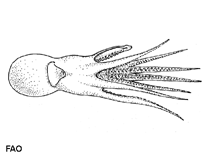
Cephalopoda |
Octopoda |
Octopodidae | Bathypolypodinae
Environnement : milieu / zone climatique / profondeur / gamme de distribution
Écologie
Bathydémersal; profondeur 200 - 2300 m (Réf. 104052), usually 400 - 700 m (Réf. 1958). Subtropical; 12°C - ? (Réf. 1964)
Eastern Atlantic and the Mediterranean: Iberian Peninsula from Bay of Biscay to Cape Verde.
Longueur à la première maturité / Taille / Poids / Âge
Maturité: Lm ? range ? - ? cm Max length : 10.0 cm ML mâle / non sexé; (Réf. 104052)
Bathybenthic (Ref. 1962). Large individuals were found down to 1400 m and small ones were found down to 1835 m (Ref. 1962). Exhibits up-slope ontogenetic migration of juveniles to depths shallower than 1200 to 1400 m (Ref. 1958).
Cycle de vie et comportement reproducteur
Maturité | Reproduction | Frai | Œufs | Fécondité | Larves
Members of the class Cephalopoda are gonochoric. Male and female adults usually die shortly after spawning and brooding, respectively. Mating behavior: Males perform various displays to attract potential females for copulation. During copulation, male grasp the female and inserts the hectocotylus into the female's mantle cavity where fertilization usually occurs. Life cycle: Embryos hatch into planktonic stage and live for some time before they grow larger and take up a benthic existence as adults.
Quetglas, A, M. Gonzales, A. Carbonell and P. Sánchez 2001 Biology of the deep-sea octopus Bathypolypus sponsalis (Cephalopoda: Octopodidae) from the wetern Mediterranean Sea. Mar. Biol. 138:785-792. (Réf. 1958)
Statut dans la liste rouge de l'IUCN
(Réf. 130435: Version 2025-2 (Global))
statut CITES (Réf. 108899)
Not Evaluated
Not Evaluated
Menace pour l'homme
Utilisations par l'homme
FAO - Publication: search | FishSource |
Outils
Plus d'informations
Dynamique des populations Cycle de vieReproductionMaturitéFéconditéFraiŒufsDéveloppement de l'œufLarves PhysiologieConsommation d'oxygène
Liées à l'hommeTimbres, pièces de monnaie, divers
Sources Internet
Estimations basées sur des modèles
Vulnérabilité de la pêche
(Réf. 71543) |
Low vulnerability (10 of 100). |
Catégorie de prix
(Réf. 80766): |
High. |