Cephalopoda |
Octopoda |
Octopodidae
Окружающая среда: среда / климатическая зона / пределы глубины / диапазон распространения
экология
ассоциированный с рифами; пределы глубины 0 - 150 m (ссылка 113260). Tropical; 33°N - 36°S, 30°E - 134°W (ссылка 275)
Indo-Pacific: from eastern Africa to Hawaiian Islands.
Длина при первой зрелости / Размер / Вес / Возраст
половая зрелость: Lm ?, range 8 - ? cm Max length : 22.0 cm ML самец/пол неопределен; (ссылка 122030); наибольший вес (опубликованные данные): 6.0 kg (ссылка 81543)
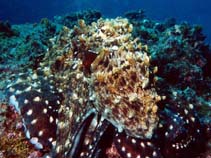
Shallow-water benthic species inhabiting coral reefs and found in a variety of substrata (Ref. 81543). Occupies lairs in coral bedrock, live and dead coral heads and excavations in sand and rubble (Ref. 96968). In naturally-occurring holes on rocks or dens (Ref. 81543). Males and females can occupy adjacent dens (Ref. 96968). Juveniles rapidly form homes and defend these against conspecifics (Ref. 105171). Opportunistic predator that predominantly uses tactile foraging methods (Ref. 81543). Reported to pounce and capture crabs. Another feeding strategy involves speculative hunting where an individual uses its interbrachial web to cover and explore with the tips of its arms the coral heads, rocks or clumps of algae (Ref. 105172). Feeds primarily on bivalves, gastropods and xanthid crabs. Employs crypsis in reaction to threat (Ref. 81543). Exhibits diurnal activity (Ref. 105171). Day-active species with higher activity peaks at dusk and dawn (Ref. 96968).
Жизненный цикл и брачное поведение
половая зрелость | размножение | нерест | икра | Плодовитость | личинки
Members of the class Cephalopoda are gonochoric. Male and female adults usually die shortly after spawning and brooding, respectively. Mating behavior: Males perform various displays to attract potential females for copulation. During copulation, male grasp the female and inserts the hectocotylus into the female's mantle cavity where fertilization usually occurs. Life cycle: Embryos hatch into planktonic stage and live for some time before they grow larger and take up a benthic existence as adults.
Основная ссылка
ссылки | координатор | соавторы
Roper, C.F.E., M.J. Sweeney and C.E. Nauen 1984 FAO Species Catalogue. Vol. 3. Cephalopods of the world. An annotated and illustrated catalogue of species of interest to fisheries. FAO Fish. Synop. 125(3):277p. Rome: FAO. (ссылка 275)
Статус Красного Списка МСОП
(ссылка 130435: Version 2025-2 (Global))
Статус СИТЕС (ссылка 108899)
Not Evaluated
CMS (ссылка 116361)
Not Evaluated
Угроза для людей
Использование человеком
рыболовство: коммерческий
FAO - Publication: search | FishSource | Море вокруг нас
инструменты
дополнительная информация
Динамика численности населения ФизиологияПотребление кислорода
Связанные с человекомМарки, монеты и прочее.
Информационно-просветительская работа
ресурсы в Интернет
Оценки, основанные на моделях
Rate of population increase
|
Prior r = 0.49, 95% CL = 0.33 - 0.74, Based on 2 data-limited stock assessments. |
Уязвимость рыбной ловли
(ссылка 71543) |
Low vulnerability (12 of 100). |
Категория цены
(ссылка 80766): |
Low. |
Nutrients
|
Calcium = 126 [75, 177] mg/100g; Iron = 4.79 [1.67, 7.92] mg/100g; Protein = 15.5 [13.7, 17.4] %; Omega3 = 0.414 [0.262, 0.566] g/100g; Selenium = 57.8 [48.5, 67.2] μg/100g; VitaminA = 0 μg/100g; Zinc = 1.97 [0.92, 3.02] mg/100g (wet weight); based on nutrient studies. |