Pycnogonida |
Pantopoda |
Phoxichilidiidae
Umwelt: Milieu / Klimazone / Tiefenbereich / Verbreitungsgebiet
Ökologie
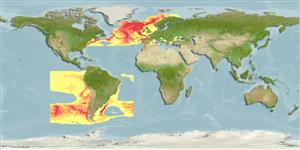
Benthic; tiefenbereich 4 - 5000 m (Ref. 1844). Tropical; 77°N - 56°S, 98°W - 42°E
Southeast Pacific, Atlantic Ocean, Mediterranean and Black Sea.
Länge bei der ersten Reifung / Größe / Gewicht / Alter
Geschlechtsreife: Lm ? range ? - ? cm
Trunk slender, unsegmented; lateral processes at least twice as long as their diameters, with very small dorsodistal tubercles and tiny setae. Neck very slender, extending in arc well anterior above proboscis. Ocular tubercle slightly longer than twice its diameter; eyes large. Placed distally, proximal to small apical cone. Proboscis cylindrical, constricted distally. Abdomen tall, slender, with distal setae. Chelifores long, slender, with several dorsal setae; chelae palms rectangular, swollen; fingers slender, without teeth. Ovigers long; third segment more than twice length of second; 2 terminal segments with many setae. Legs long, increasingly setose distally; long dorsodistal spines usually longer than segment diameter; cement gland tube half as long as segment diameter; propodus long, slender, with 2 major heel spines, 4 setae, and long lamina more than half sole length; claw long; auxiliaries tiny but distinct (Ref. 2115, p. 54).
Bathymetrical range; intertidal to abyssal depths (Ref. 2015, page 216). Coastal to slope (Ref. 19). Epibiotic (Ref. 12'>116112). Found on muddy substrate. A carnivore-scavenger (Ref. 96352). Feeds on hosts: Dynamena pumila. It seizes the stems of the hydroid using the apposition of the propodal sole spine and the terminal claws of the legs. Pieces are torn from the hydranth by the chelifores and transferred to the mouth where they are ingested (Ref. 12). Larvae frequently found on Obelia sp. and recorded as well in Clytia hemispherica (Ref. 121217). Feeds mostly at night, avoids touching the hydroid polyps, feeding mostly on the tips of spines (Ref. 121217). It also feeds on Syncoryne eximia (Ref. 12).
Lebenszyklus und Paarungsverhalten
Geschlechtsreife | Fortpflanzung | Ablaichen | Eier | Fruchtbarkeit | Larven
Development site of larval association: galls on Syncoryne eximia; in medusae of Cosmetira pilosella,Turris pileata, Stomotoca dinema, Phialidium hemisphericum and Obelia; and, inside polyps of Hydractinia echinata, Podocoryne carnea and Obelia (Ref. 213).
Raiskii, A.K. and E.P. Turpaeva 2006 Deep-sea pycnogonids from the North Atlantic their distribution in the world ocean. Okeanologiya 46(1):63-68. (Ref. 1844)
IUCN Rote Liste Status
(Ref. 130435: Version 2025-2 (Global))
CITES Status (Ref. 108899)
Not Evaluated
Not Evaluated
Bedrohung für Menschen
Nutzung durch Menschen
FAO - Publication: search | FishSource |
Tools
Mehr Information
PopulationsdynamikWachstum
Max. Alter/Größen
Länge-Gewicht-Rel.
Länge-Länge-Verhältnis.
Längenhäufigkeiten
Massenkonvertierung
Dichte
LebenszyklusFortpflanzungGeschlechtsreifeFruchtbarkeitAblaichenEierEientwicklungLarven PhysiologieSauerstoffverbrauch
MenschenbezogenBriefmarken, Münzen, Verschiedenes.
Internet Quellen
Schätzungen auf der Grundlage von Modellen
Anfälligkeit der Fischerei
(Ref. 71543) |
(0 of 100). |
Preiskategorie
(Ref. 80766): |
Unknown. |