Holothuroidea |
Holothuriida |
Holothuriidae
Ambiente: milieu / zona climatica / distribuzione batimetrica / gamma di distribuzione
Ecologia
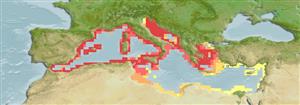
Benthic; distribuzione batimetrica 0 - 123 m (Fonte Biblio. 85345). Subtropical
Atlantic and the Mediterranean Sea: Turkey and Algeria.
Lunghezza alla prima maturità / Dimensione / Peso / Età
Maturità: Lm ? range ? - ? cm Max length : 30.0 cm TL maschio/sesso non determinato; (Fonte Biblio. 366); peso massimo pubblicato: 340.00 g (Fonte Biblio. 366)
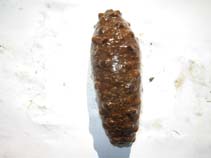
Maximum size: 25 cm (Ref. 358); approximately 30 cm. maximum width: 6 cm. Average weight: 340 g (Ref. 363). Body: with more or less round cross section; is provided with the ventral face with 3 lines with parapodes with suction cup. Tegument: comprises many papillae of sunk color, prolonged by a final silk of dark color; resistant in the majority of the cases and is very seldom thin. Variable coloring of the red with nuance of brown which some time draws on the purple one. The animal is deprived of tubes of Vat (Ref. 358).
Maximum size: 25 cm (Ref. 358); approximately 30 cm (Ref. 366). Method: Captured with the hand, with dredgers and trawls basic, and probably used like food in some countries. Fisheries: Probably one of the species which Turkey exports in Japan (Ref. 366). Habitat: Sandy rich person funds muddy out of organic remains, or on hard substrates forks and spoons of plants. Present at all depths, the species is very common, even locally very abundant, but does not seem not represented in the sectors western and southern of the basin. Biology: the tubules sea cucumber nourishes various organic fragments, (charging) literally the elements of the ground in its oral opening, located at the back of the body, using its tentacles oral of flattened form. The animal sorts and introduces the edible organic substances, and rejects the elements not metabolize, particularly sand, in the form of lengthened excrements (Ref. 358). Habitat: Very common benthic species, approximately presents littoral zone up to 100 m of depth, on the rock funds covered with algae, the meadows of Posidonia sp. and other phanerogams, sand and the mud. It is said that it moves at the speed of one meter every 10 minutes. Very often shelter fish of the Carapus sp. kind. Eviscerate easily when it is disturbed (Ref. 366). Occurs at the low tide mark.
Ciclo vitale e comportamento di accoppiamento
Maturità | Riproduzione | Deposizione | Uova | Fecondità | Larve
A migration towards surface waters occurs, especially at the end of the summer, at the end which the expenses are easily recognizable, since one sees them vertically drawing up the 2/3 of their body and expelling their gametes in the form of fine clouds in the surrounding medium (Ref. 358).
Göthel, H. 1992 Guide de la faune sous-marine: La Méditerranée. Invertébrés marins et poissons. Eygen Ulmer GmbH & Co. 318 p. (Fonte Biblio. 358)
Stato della Lista Rossa IUCN
(Fonte Biblio. 130435: Version 2025-2 (Global))
Stato della CITES (Fonte Biblio. 108899)
Not Evaluated
CMS (Fonte Biblio. 116361)
Not Evaluated
Minaccia per l'uomo
Usi umani
Pesca: commerciale
FAO - Publication: search | FishSource |
Strumenti
Informazioni ulteriori
Ecologia troficaArticoli alimentari (prede)
Alimentazione
Consumo di cibo
Predatori
Dinamica della popolazione Ciclo di vitaRiproduzioneMaturitàFeconditàDeposizioneUovaSviluppo delle uovaLarve FisiologiaConsumo di ossigeno
Legato all'uomoFrancobolli, monete, materiale vario.
Fonti Internet
Stime basate su modelli
Resilienza
(Ref. 69278): |
Alto, tempo minimo di raddoppiamento della popolazione meno di 15 mesi (K=0.66) |
Vulnerabilità della pesca
(Fonte Biblio. 71543) |
Low vulnerability (22 of 100). |
Categoria di prezzo
(Fonte Biblio. 80766): |
Unknown. |