Holothuroidea |
Holothuriida |
Holothuriidae
Umwelt: Milieu / Klimazone / Tiefenbereich / Verbreitungsgebiet
Ökologie
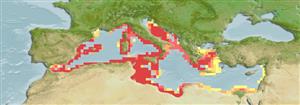
Benthic; tiefenbereich 0 - 250 m (Ref. 85345). Subtropical
Atlantic and the Mediterranean Sea: Algeria.
Länge bei der ersten Reifung / Größe / Gewicht / Alter
Geschlechtsreife: Lm ? range ? - ? cm Max length : 20.0 cm TL Männchen/unbestimmt; (Ref. 358)
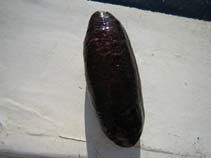
Maximum size: 20 cm. Body: with more or less round cross section; is provided with the ventral face with 3 lines with podia with suction cups. Tegument: constellated with multiple papillae. Color: supported black; papillae being very of an immaculate white. Absence of tubes of Vat (Ref. 358).
Maximum size: 20 cm. Species presents the small funds until largest the depths, but rare. Habitat: Hard funds and herbaria. Biology: this species is nourished, using its tentacles oral flattened, of various organic fragments. It (charges) literally elements of the ground in its oral opening, located at the back of the body. The animal sorts the edible organic substances, and rejects the elements not metabolized such as sand, in the form of roved excrements (Ref. 358).
Lebenszyklus und Paarungsverhalten
Geschlechtsreife | Fortpflanzung | Ablaichen | Eier | Fruchtbarkeit | Larven
Members of the class Holothuroidea are gonochoric and have only one gonad. Spawning and fertilization are both external and some exhibit brooding. Life cycle: Embryos develop into planktotrophic larvae (auricularia) then into doliolaria (barrel-shaped stage) which later metamorphose into juvenile sea cucumbers.
Göthel, H. 1992 Guide de la faune sous-marine: La Méditerranée. Invertébrés marins et poissons. Eygen Ulmer GmbH & Co. 318 p. (Ref. 358)
IUCN Rote Liste Status
(Ref. 130435: Version 2025-2 (Global))
CITES Status (Ref. 108899)
Not Evaluated
Not Evaluated
Bedrohung für Menschen
Nutzung durch Menschen
FAO - Publication: search | FishSource |
Tools
Mehr Information
Trophische ÖkologieLebensmittel (Beutetiere)NahrungszusammensetzungNahrungsaufnahmeRäuber LebenszyklusFortpflanzungGeschlechtsreifeFruchtbarkeitAblaichenEierEientwicklungLarven PhysiologieSauerstoffverbrauch
MenschenbezogenBriefmarken, Münzen, Verschiedenes.
Internet Quellen
Schätzungen auf der Grundlage von Modellen
Widerstandsfähigkeit
(Ref. 69278): |
hoch, Verdopplung der Population dauert weniger als 15 Monate. (K=0.69) |
Anfälligkeit der Fischerei
(Ref. 71543) |
Low vulnerability (17 of 100). |
Preiskategorie
(Ref. 80766): |
Unknown. |