Echinoidea |
Camarodonta |
Echinidae
Milieu: milieu / Klimaatzone / Diepte / verspreidingsgebied
Ecologie
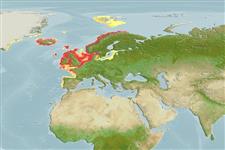
Benthic; diepte 0 - 100 m (Ref. 96312). Temperate, preferred 10°C (Ref. 107945); 81°N - 38°N, 43°W - 30°E
Northeast Atlantic: From Svalbard, UK and the Faeroes, east to the North Sea, Skagerrak and Kattegat to Finnmark, Norway, north to Greenland and Iceland and south to Portugal. Temperate to polar.
Lengte bij maturiteit / Grootte / Gewicht / Leeftijd
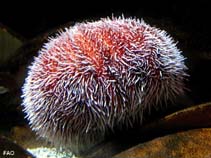
Maturiteit: Lm ? range ? - ? cm Max length : 17.6 cm WD mannelijk / geslacht onbekend; (Ref. 101443); max. gerapporteerde leeftijd: 8 Jaren (Ref. 101443)
It is found on the upper subtidal, and intertidally on low spring tides from depths of 0 to 100 meters. They graze and feed on a variety of plant and animal material (Ref. 96312).
Levenscyclus en paargedrag
Maturiteit | Voortplanting | Paaien | Eieren | Fecunditeit | Larven
Small eggs, seasonally produced, spawning varies with latitude (Ref. 96312).
Harms, J. 1993 Check list of species (algae, invertebrates and vertebrates) found in the vicinity of the island of Helgoland (North Sea, German Bight) - a review of recent records. Helgoländer Meeresunters 47:1-34. (Ref. 2711)
Status op de Rode Lijst van het IUCN
(Ref. 130435: Version 2025-2 (Global))
CITES status (Ref. 108899)
Not Evaluated
Not Evaluated
Gevaar voor de mens
Gebruik door de mens
Visserij: commercieel
FAO - visserij: landings search; Publication: search | FishSource | Sea Around Us
Tools
Meer informatie
PopulatiedynamicaGroeiMax. leeftijden / matenLengte-gewicht rel.Lengte-lengte rel.LengtefrequentiesMassaconversieAbundantie LevenscyclusVoortplantingMaturiteitFecunditeitPaaienEierenOntwikkeling van de eierenLarven FysiologieZuurstofverbruik
Menselijk gerelateerdPostzegels, munten, diversen.
Internetbronnen
Schattingen op basis van modellen
Kwetsbaarheid van de visserij
(Ref. 71543) |
Low to moderate vulnerability (28 of 100). |
Kwetsbaarheid voor het klimaat
(Ref. 125649) |
Moderate to high vulnerability (48 of 100) |
Prijsklasse
(Ref. 80766): |
Unknown. |
Nutrients
|
Calcium = 126 [75, 177] mg/100g; Iron = 5.08 [1.67, 7.92] mg/100g; Protein = 12%; Omega3 = 0.331 [0.263, 0.400] g/100g; Selenium = 0.04 [48.48, 67.17] μg/100g; VitaminA = 0 μg/100g; Zinc = 1.97 [0.92, 3.02] mg/100g (wet weight); based on nutrient studies. |