Bivalvia |
Cardiida |
Tellinidae
Environnement : milieu / zone climatique / profondeur / gamme de distribution
Écologie
Benthic. Tropical
Western Atlantic.
Longueur à la première maturité / Taille / Poids / Âge
Maturité: Lm ? range ? - ? cmCommon length : 9.8 cm TL mâle / non sexé; (Réf. 344)
Description synthétique
Morphologie
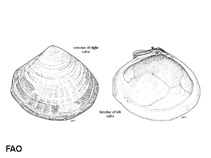
Shell subcircular, heavy, inequivalve. Shell surface smooth except for fine, irregular growth lines. Hinge well developed, with posterior lateral tooth long and strong. Pallial sinus large, well developed. Umbones at central part of dorsal region. Oblique ridge runs from umbo to middle of posterior margin. Posterior shell margin sinuous in posterior view: posterior margin of right valve concave and of left valve concave. Colour: externally white, internally glossier white with yellow tinges.
In shallow water, deeply burrowing in intertidal sand near seagrass beds (Ref. 344).
Cycle de vie et comportement reproducteur
Maturité | Reproduction | Frai | Œufs | Fécondité | Larves
Members of the class Bivalvia are mostly gonochoric, some are protandric hermaphrodites. Life cycle: Embryos develop into free-swimming trocophore larvae, succeeded by the bivalve veliger, resembling a miniature clam.
Leal, J.H. 2003 Bivalves. p. 25-98. In Carpenter, K.E. (ed.). The living marine resources of the Western Central Atlantic. Volume 1: Introduction, molluscs, crustaceans, hagfishes, sharks, batoid fishes, and chimaeras. FAO Species Identification Guide for Fishery Purposes and American Society of Ichthyologists and Herpetologists Special Publication No. 5. 1600p. (Réf. 344)
Statut dans la liste rouge de l'IUCN
(Réf. 130435: Version 2025-2 (Global))
statut CITES (Réf. 108899)
Not Evaluated
Not Evaluated
Menace pour l'homme
Utilisations par l'homme
Pêcheries: commercial
FAO - Publication: search | FishSource |
Outils
Plus d'informations
Écologie trophiqueAliments (proies)
Composition du régime alimentaire
Consommation alimentaire
Prédateurs
Dynamique des populationsCroissance
Âges / tailles maximales
Longueur-poids rel.
Rel. longueur-longueur.
Fréquences de longueurs
Conversion de masse
Abondance
Cycle de vieReproductionMaturitéFéconditéFraiŒufsDéveloppement de l'œufLarves PhysiologieConsommation d'oxygène
Liées à l'hommeTimbres, pièces de monnaie, divers
Sources Internet
Estimations basées sur des modèles
Vulnérabilité de la pêche
(Réf. 71543) |
(0 of 100). |
Catégorie de prix
(Réf. 80766): |
Unknown. |