Bivalvia |
Cardiida |
Donacidae
Lingkungan: lingkungan / zona iklim / kisaran kedalaman / jangkauan distribusi
Ekologi
Benthic; kisaran kedalaman 0 - 1 m (Acuan 83435). Tropical
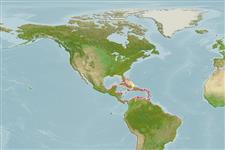
Western Atlantic: Caribbean to Brazil.
Panjang pada saat jatuh tempo pertama / Ukuran / Berat / umur
Kematangan: Lm ? range ? - ? cm Max length : 1.8 cm DL jantan/; (Acuan 83435); common length : 2.5 cm TL jantan/; (Acuan 344); Umur maksimum dilaporkan: 2.00 Tahun (Acuan 8702)
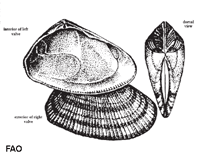
Shell wedge-shaped, inflated. Posterior slope with 2 curved ridges. Surface sculpture consisting of fine radial grooves of microscopic pinpoints. Colour: variable, usually brown, yellowish or purple, with rays of darker hues (Ref. 344).
Assumed total length is 2.5 cm (Ref. 344). Maximum depth from Ref. 104365. Found on beach and shoreline (Ref. 104365). Infaunal in shallow sand, usually in environments rich in particulate organic matter (Ref. 344).
Siklus hidup dan perilaku kawin
Kematangan | Reproduksi, perkembang biakan | Pemijahan | telur-telur | Fekunditas | Larva
Members of the class Bivalvia are mostly gonochoric, some are protandric hermaphrodites. Life cycle: Embryos develop into free-swimming trocophore larvae, succeeded by the bivalve veliger, resembling a miniature clam.
rujukan utama
Acuan | Koordinator | mitra
Leal, J.H. 2003 Bivalves. p. 25-98. In Carpenter, K.E. (ed.). The living marine resources of the Western Central Atlantic. Volume 1: Introduction, molluscs, crustaceans, hagfishes, sharks, batoid fishes, and chimaeras. FAO Species Identification Guide for Fishery Purposes and American Society of Ichthyologists and Herpetologists Special Publication No. 5. 1600p. (Acuan 344)
Status IUCN Red List
(Acuan 130435: Version 2025-2 (Global))
status CITES (Acuan 108899)
Not Evaluated
Not Evaluated
ancaman kepada manusia
penggunaan manusia
FAO - Publication: search | FishSource |
Alat, peralatan
informasi lanjut
Ekologi trofikItem makanan (mangsa)
Komposisi makanan
Konsumsi makanan
Pemangsa
FisiologiKonsumsi oksigen
Yang berhubungan dengan manusiaPerangko, koin, dll.
Sumber internet
Estimasi berdasarkan model
Daya lenting
(Ref. 69278): |
Tinggi, Waktu penggandaan populasi minimum kurang dari 15 bulan (K=0.43-1.79; tmax=2) |
Kerentanan Penangkapan Ikan
(Acuan 71543) |
Low vulnerability (10 of 100). |
kategori harga
(Acuan 80766): |
Medium. |