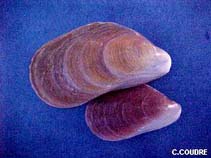
Bivalvia |
Mytilida |
Mytilidae
Milieu: milieu / Klimaatzone / Diepte / verspreidingsgebied
Ecologie
Benthic; diepte 3 - 200 m (Ref. 2754). Subtropical; 62°N - 8°N, 32°W - 78°E
Eastern Atlantic, Mediterranean and Black Sea: from UK south to Mauritania and east to India.
Lengte bij maturiteit / Grootte / Gewicht / Leeftijd
Maturiteit: Lm ? range ? - ? cm Max length : 6.6 cm SHL mannelijk / geslacht onbekend; (Ref. 7859); common length : 3.0 cm SHL mannelijk / geslacht onbekend; (Ref. 7859); max. gerapporteerde leeftijd: 13 Jaren (Ref. 80239)
Minimum depth from Ref. 122114. Generally occurs in marine coastal habitats (Ref. 122115). Occurs in the lower eulittoral-sublittoral fringe from lower depths to 110 m (Ref. 7859). Main food and feeding type based on another species of the same Genus; to be replaced with a better reference (Ref. 95810).
Levenscyclus en paargedrag
Maturiteit | Voortplanting | Paaien | Eieren | Fecunditeit | Larven
Members of the class Bivalvia are mostly gonochoric, some are protandric hermaphrodites. Life cycle: Embryos develop into free-swimming trocophore larvae, succeeded by the bivalve veliger, resembling a miniature clam.
Demir, M. 2003 Shells of mollusca collected from the seas of Turkey. Turkey Journal of Zoology 27:101-140. (Ref. 2754)
Status op de Rode Lijst van het IUCN
(Ref. 130435: Version 2025-2 (Global))
CITES status (Ref. 108899)
Not Evaluated
Not Evaluated
Gevaar voor de mens
Gebruik door de mens
Visserij: commercieel
FAO - Publication: search | FishSource |
Tools
Meer informatie
LevenscyclusVoortplantingMaturiteitFecunditeitPaaienEierenOntwikkeling van de eierenLarven FysiologieZuurstofverbruik
Menselijk gerelateerdPostzegels, munten, diversen.
Internetbronnen
Schattingen op basis van modellen
Weerstandsvermogen
(Ref. 69278): |
Gemiddeld, minimale populatieverdubbelingstijd 1,4-4,4 jaar (K=0.18-0.21; tmax=13) |
Kwetsbaarheid van de visserij
(Ref. 71543) |
Moderate vulnerability (39 of 100). |
Prijsklasse
(Ref. 80766): |
High. |