Hexacorallia |
Scleractinia |
Merulinidae
Umwelt: Milieu / Klimazone / Tiefenbereich / Verbreitungsgebiet
Ökologie
Riff-verbunden; tiefenbereich 3 - 40 m (Ref. 8294). Tropical; 36°N - 34°S, 32°E - 108°W (Ref. 848)
Indo-Pacific: Japan to Australia and Red Sea to Easter Island.
Länge bei der ersten Reifung / Größe / Gewicht / Alter
Geschlechtsreife: Lm ? range ? - ? cm
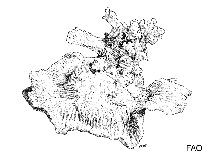
Corallites are small, moderately plocoid, distinct, and almost circular. Color is usually grey-green.
Maximum depth from Ref. 98471. Occurs at intertidal rock pools, subtidal reefs (Ref. 88997), especially rocky reefs, outer reef channel, back and foreslope and in lagoons (Ref. 98471).
Lebenszyklus und Paarungsverhalten
Geschlechtsreife | Fortpflanzung | Ablaichen | Eier | Fruchtbarkeit | Larven
Hermaphroditic (Ref. 113712). Mature gametes are shed into the coelenteron and spawned through the mouth. Life cycle: The zygote develops into a planktonic planula larva. Metamorphosis begins with early morphogenesis of tentacles, septa and pharynx before larval settlement on the aboral end (Ref. 833).
Ross, M.A. and G. Hodgson 1981 A quantitative study of hermatypic coral diversity and zonation at Apo Reef, Mindiro, Philippines. Proceedings of the Fourth International Coral Reef Syposium, Manila 2:281-291. (Ref. 8294)
IUCN Rote Liste Status
(Ref. 130435: Version 2025-2 (Global))
CITES Status (Ref. 108899)
Not Evaluated
Bedrohung für Menschen
Nutzung durch Menschen
FAO - Publication: search | FishSource |
Tools
Mehr Information
Trophische ÖkologieLebensmittel (Beutetiere)
Nahrungszusammensetzung
Nahrungsaufnahme
Räuber
PopulationsdynamikWachstumMax. Alter/GrößenLänge-Gewicht-Rel.Länge-Länge-Verhältnis.LängenhäufigkeitenMassenkonvertierungDichte PhysiologieSauerstoffverbrauch
MenschenbezogenBriefmarken, Münzen, Verschiedenes.
Internet Quellen
Schätzungen auf der Grundlage von Modellen
Anfälligkeit der Fischerei
(Ref. 71543) |
(0 of 100). |
Preiskategorie
(Ref. 80766): |
Unknown. |