Hexacorallia |
Scleractinia |
Faviidae
Milieu: milieu / Klimaatzone / Diepte / verspreidingsgebied
Ecologie
Rifbewoner; diepte 0 - 65 m (Ref. 848). Tropical; 33°N - 8°N, 92°W - 58°W (Ref. 848)
Western Atlantic: Gulf of Mexico, Caribbean to Bermuda.
Lengte bij maturiteit / Grootte / Gewicht / Leeftijd
Maturiteit: Lm ? range ? - ? cm
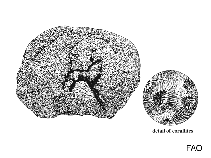
Colony: either free-living with cone-shaped undersurface, or attached. Small colonies: oval shaped, with a central axial valley with short side valleys. Larger colonies: hemispherical, meandroid. With distinct ambulacral groove along the tops of valley walls (Ref. 848).
Maximum depth from Ref. 83917. Zooxanthellate (Ref. 116012). Small and free-living colonies in subtidal seagrass beds; attached and hemispherical in shallow reef environments (Ref. 848). Also common in sand and coral rubble (Ref. 415)
Levenscyclus en paargedrag
Maturiteit | Voortplanting | Paaien | Eieren | Fecunditeit | Larven
Hermaphroditic (Ref. 113712). Mature gametes are shed into the coelenteron and spawned through the mouth. Life cycle: The zygote develops into a planktonic planula larva. Metamorphosis begins with early morphogenesis of tentacles, septa and pharynx before larval settlement on the aboral end (Ref. 833).
Collin, R., M.C. Díaz, J. Norenburg, R.M. Rocha, J.A. Sánchez, M. Schulze, A. Schwartz and A. Valdés 2005 Photographic identification guide to some common marine invertebrates of Bocas Del Toro, Panama. Caribbean Journal of Science. 41(3):638-707. (Ref. 415)
Status op de Rode Lijst van het IUCN
(Ref. 130435: Version 2025-2 (Global))
CITES status (Ref. 108899)
Not Evaluated
Gevaar voor de mens
Gebruik door de mens
FAO - Publication: search | FishSource |
Tools
Meer informatie
Trofische ecologieVoedsel (prooien)
Dieetsamenstelling
Voedselconsumptie
Predatoren
PopulatiedynamicaGroei
Max. leeftijden / maten
Lengte-gewicht rel.
Lengte-lengte rel.
Lengtefrequenties
Massaconversie
Abundantie
FysiologieZuurstofverbruik
Menselijk gerelateerdPostzegels, munten, diversen.
Internetbronnen
Schattingen op basis van modellen
Kwetsbaarheid van de visserij
(Ref. 71543) |
(0 of 100). |
Prijsklasse
(Ref. 80766): |
Unknown. |