-

- About this page
- Languages
-
Feedback
- Citation
- Upload
-
Related species
- Species in
Dipsastraea - Species in
Merulinidae - - Classification -
- Merulinidae
- Scleractinia
- Hexacorallia
- Chordata
- Animalia
- Species in
-



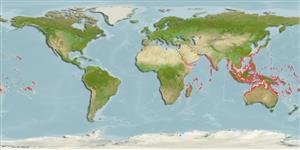
Dipsastraea pallida (Dana, 1846)
| Native range | All suitable habitat | Point map | Year 2050 |
|
| This map was computer-generated and has not yet been reviewed. |
| Dipsastraea pallida AquaMaps Data sources: GBIF OBIS |
Upload your photos
Google image |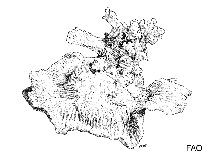 No image available for this species;
drawing shows typical species in Merulinidae.
Google image |
drawing shows typical species in Merulinidae.
Classification / Names Common names | Synonyms | CoL | ITIS | WoRMS
Hexacorallia | Scleractinia | Merulinidae
Environment: milieu / climate zone / depth range / distribution range Ecology
Reef-associated; depth range 6 - 30 m (Ref. 115199). Tropical; 36°N - 34°S, 26°E - 137°W (Ref. 848)
Distribution Countries | FAO areas | Ecosystems | Occurrences | Introductions
Indo-Pacific. Tropical to subtropical.
Length at first maturity / Size / Weight / Age
Maturity: Lm ? range ? - ? cm
Short description Morphology
Colony: massive. Corallites: circular, closely compacted in shallow water, more widely spaced in deeper water. Septa: widely spaced, distinctly irregular. Often poorly developed paliform lobes. Color: pale yellow, cream or green, with dark brown or green oral discs (Ref. 848).
Minimum depth from Ref. 104515. Found in all reef environments, often a dominant species of back reef margins (Ref. 848). Also on subtidal rock, rocky reefs, outer reef channel, back and foreslope and lagoons; occasionally in inter-reef soft substrate (Ref. 98471). Tends to form low heads or encrust rocks in shallow waters (Ref. 130769).
Life cycle and mating behavior Maturity | Reproduction | Spawning | Eggs | Fecundity | Larvae
Hermaphroditic (Ref. 113712). Mature gametes are shed into the coelenteron and spawned through the mouth. Life cycle: The zygote develops into a planktonic planula larva. Metamorphosis begins with early morphogenesis of tentacles, septa and pharynx before larval settlement on the aboral end (Ref. 833).
Main reference
References | Coordinator | Collaborators
Ross, M.A. and G. Hodgson 1981 A quantitative study of hermatypic coral diversity and zonation at Apo Reef, Mindiro, Philippines. Proceedings of the Fourth International Coral Reef Syposium, Manila 2:281-291. (Ref. 8294)
IUCN Red List Status
(Ref. 130435: Version 2025-1)
Least Concern (LC) ; Date assessed: 24 October 2023
CITES status (Ref. 108899)
Appendix II: International trade monitored
CMS (Ref. 116361)
Not Evaluated
Threat to humans
Human uses
| FishSource |
Tools
More information
Trophic Ecology
Food items (preys)
Diet composition
Food consumption
Predators
Diet composition
Food consumption
Predators
Ecology
Population dynamics
Growth
Max. ages / sizes
Length-weight rel.
Length-length rel.
Length-frequencies
Mass conversion
Abundance
Max. ages / sizes
Length-weight rel.
Length-length rel.
Length-frequencies
Mass conversion
Abundance
Life cycle
Distribution
Physiology
Oxygen consumption
Human Related
Stamps, coins, misc.
Outreach
References
Internet sources
BHL | BOLD Systems | CISTI | DiscoverLife | FAO(Publication : search) | Fishipedia | GenBank (genome, nucleotide) | GloBI | Gomexsi | Google Books | Google Scholar | Google | PubMed | Tree of Life | Wikipedia (Go, Search) | Zoological Record
Estimates based on models
Preferred temperature
(Ref. 115969): 22 - 28.2, mean 26.6 (based on 561 cells).
Price category
(Ref. 80766):
Unknown.