Hexacorallia |
Scleractinia |
Acroporidae
Ambiente: milieu / zona climatica / distribuzione batimetrica / gamma di distribuzione
Ecologia
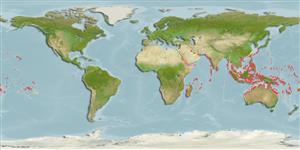
Associati a barriera corallina; distribuzione batimetrica 3 - 10 m (Fonte Biblio. 98622). Tropical; 30°N - 34°S, 27°E - 135°W (Fonte Biblio. 846)
Indo-Pacific. Tropical to subtropical.
Lunghezza alla prima maturità / Dimensione / Peso / Età
Maturità: Lm ? range ? - ? cm Max length : 19.9 cm BRL maschio/sesso non determinato; (Fonte Biblio. 269); common length : 2.5 cm BRW maschio/sesso non determinato; (Fonte Biblio. 269)
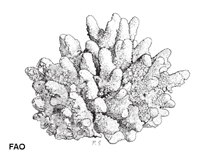
A corymbose growth form distinguishes this spcies. Individual branches form fat fingers, 0.1-0.25 cm in diameter and less than 20 cm in length, with little secondary branching. Due to solid construction, these species is found on exposed reefs throughout its range in shallow to intermediate depths (Ref. 269).
Can be found in shallow waters (Ref. 122680). Found on exposed reefs throughout its range in shallow to intermediate depths (Ref. 269) on reef tops, upper slopes and submerged reefs (Ref. 86439). Also on reef flats (Ref. 98471).
Ciclo vitale e comportamento di accoppiamento
Maturità | Riproduzione | Deposizione | Uova | Fecondità | Larve
Hermaphroditic (Refs. 113708, 113712). Mature gametes are shed into the coelenteron and spawned through the mouth. Life cycle: The zygote develops into a planktonic planula larva. Metamorphosis begins with early morphogenesis of tentacles, septa and pharynx before larval settlement on the aboral end (Ref. 833).
Wallace, C.C. 1999 Staghorn corals of the world. A revision of the genus Acropora (Scleractinia; Astrocoeniina; Acroporidae) worldwide, with emphasis on morphology, phylogeny and biogeography. CSIRO Publishing. 421 p. (Fonte Biblio. 86439)
Stato della Lista Rossa IUCN
(Fonte Biblio. 130435: Version 2025-2 (Global))
Stato della CITES (Fonte Biblio. 108899)
CMS (Fonte Biblio. 116361)
Not Evaluated
Minaccia per l'uomo
Usi umani
FAO - Publication: search | FishSource |
Strumenti
Informazioni ulteriori
Ecologia troficaArticoli alimentari (prede)
Alimentazione
Consumo di cibo
Predatori
Dinamica della popolazioneAccrescimentoEtà massima / dimensioni massimeRapporto lunghezza-peso.Lunghezza-lunghezza rel.Lunghezza-frequenzeConversione di massaAbbondanza FisiologiaConsumo di ossigeno
Legato all'uomoFrancobolli, monete, materiale vario.
Fonti Internet
Stime basate su modelli
Vulnerabilità della pesca
(Fonte Biblio. 71543) |
Low vulnerability (10 of 100). |
Categoria di prezzo
(Fonte Biblio. 80766): |
Unknown. |