Hexacorallia |
Scleractinia |
Acroporidae
Milieu: milieu / Klimaatzone / Diepte / verspreidingsgebied
Ecologie
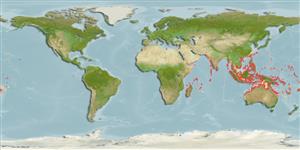
Rifbewoner; diepte 3 - 35 m (Ref. 8294). Tropical; 28°N - 30°S, 41°E - 169°W (Ref. 846)
Indo-Pacific.
Lengte bij maturiteit / Grootte / Gewicht / Leeftijd
Maturiteit: Lm ? range ? - ? cm
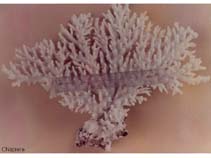
Corymbose clumps colonies. Thin and spreading horizontal branches. Fine upward projecting branches. Naniform radial corallites on branch sides with slightly flaring lips. Usual color: Grey or bright blue-green or yellow. Branch tips: Yellow, lime, green, pale blue or brown.
Maximum depth from Ref. 98471. Inhabits upper reef slopes, lagoons (Ref. 846) and walls (Ref. 98471).
Levenscyclus en paargedrag
Maturiteit | Voortplanting | Paaien | Eieren | Fecunditeit | Larven
Hermaphroditic (Ref. 113712). Mature gametes are shed into the coelenteron and spawned through the mouth. Life cycle: The zygote develops into a planktonic planula larva. Metamorphosis begins with early morphogenesis of tentacles, septa and pharynx before larval settlement on the aboral end (Ref. 833).
Veron, J.E.N. 2000 Corals of the world. Volume 1. Australian Institute of Marine Science and CRR Qld. Pty. Ltd. Australia. 463 p. (Ref. 846)
Status op de Rode Lijst van het IUCN
(Ref. 130435: Version 2025-2 (Global))
CITES status (Ref. 108899)
Not Evaluated
Gevaar voor de mens
Gebruik door de mens
FAO - Publication: search | FishSource |
Tools
Meer informatie
Trofische ecologieVoedsel (prooien)
Dieetsamenstelling
Voedselconsumptie
Predatoren
PopulatiedynamicaGroeiMax. leeftijden / matenLengte-gewicht rel.Lengte-lengte rel.LengtefrequentiesMassaconversieAbundantie FysiologieZuurstofverbruik
Menselijk gerelateerdPostzegels, munten, diversen.
Internetbronnen
Schattingen op basis van modellen
Kwetsbaarheid van de visserij
(Ref. 71543) |
(0 of 100). |
Prijsklasse
(Ref. 80766): |
Unknown. |