Hexacorallia |
Scleractinia |
Agariciidae
Umwelt: Milieu / Klimazone / Tiefenbereich / Verbreitungsgebiet
Ökologie
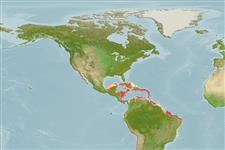
Riff-verbunden; tiefenbereich 0 - 80 m (Ref. 847). Subtropical; 24°N - 25°S, 98°W - 31°W (Ref. 847)
Western Atlantic: Caribbean Sea and East Brazil Self.
Länge bei der ersten Reifung / Größe / Gewicht / Alter
Geschlechtsreife: Lm ? range ? - ? cm
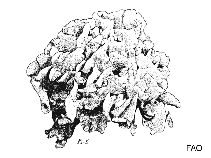
Colonies form flat or upright unifacial explanate plates with corallites in long, roughly concentric valleys. Valleys are usually widely-spaced, flat-bottomed and indistinct. Corallites are small and closed together and occur in the outward facing edge of the valley walls (collines). Colummellae are well-developed. Usually dark yellow, green or brown in color.
Maximum depth from Ref. 116012. Zooxanthellate (Ref. 116012).
Lebenszyklus und Paarungsverhalten
Geschlechtsreife | Fortpflanzung | Ablaichen | Eier | Fruchtbarkeit | Larven
Members of the class Anthozoa are either gonochoric or hermaphroditic. Mature gametes are shed into the coelenteron and spawned through the mouth. Life cycle: The zygote develops into a planktonic planula larva. Metamorphosis begins with early morphogenesis of tentacles, septa and pharynx before larval settlement on the aboral end.
Cairns, S.D., D.R. Calder, A. Brinckmann-Voss, C.B. Castro, D.G. Fautin, P.R. Pugh, C.E. Mills, W.C. Jaap, M.N. Arai, S.H.D. Haddock and D.M. Opresko 2003 Common and Scientific Names of Aquatic Invertebrates from the United States and Canada: Cnidaria and Ctenophore, Second Edition. American Fisheries Society Special Publication, no,28. XI+115. With CD-ROM. (Ref. 1663)
IUCN Rote Liste Status
(Ref. 130435: Version 2025-2 (Global))
CITES Status (Ref. 108899)
Not Evaluated
Bedrohung für Menschen
Nutzung durch Menschen
FAO - Publication: search | FishSource |
Tools
Mehr Information
Trophische ÖkologieLebensmittel (Beutetiere)
Nahrungszusammensetzung
Nahrungsaufnahme
Räuber
PopulationsdynamikWachstum
Max. Alter/Größen
Länge-Gewicht-Rel.
Länge-Länge-Verhältnis.
Längenhäufigkeiten
Massenkonvertierung
Dichte
LebenszyklusFortpflanzungGeschlechtsreifeFruchtbarkeitAblaichenEierEientwicklungLarven PhysiologieSauerstoffverbrauch
MenschenbezogenBriefmarken, Münzen, Verschiedenes.
Internet Quellen
Schätzungen auf der Grundlage von Modellen
Anfälligkeit der Fischerei
(Ref. 71543) |
(0 of 100). |
Preiskategorie
(Ref. 80766): |
Unknown. |