Hexacorallia |
Scleractinia |
Acroporidae
Environnement : milieu / zone climatique / profondeur / gamme de distribution
Écologie
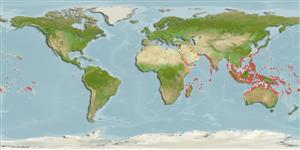
Récifal; profondeur 0 - 20 m (Réf. 8294). Tropical; 31°N - 32°S, 32°E - 138°W (Réf. 846)
Indo-Pacific. Tropical to subtropical.
Longueur à la première maturité / Taille / Poids / Âge
Maturité: Lm ? range ? - ? cm
Description synthétique
Morphologie
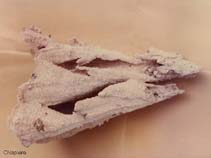
Colonies are composed of thin unifacial laminae sometimes forming tiers or whorls. Corallites are arranged in rows between coenosteum ridges, which are conspicuous and usually perpendicular to colony margins. Cream, pink or brown with pale margins (Ref. 846).
Maximum depth from Ref. 98471. Inhabits mostly protected upper reef slopes (Ref. 846).
Cycle de vie et comportement reproducteur
Maturité | Reproduction | Frai | Œufs | Fécondité | Larves
Hermaphroditic (Ref. 113712). Mature gametes are shed into the coelenteron and spawned through the mouth. Life cycle: The zygote develops into a planktonic planula larva. Metamorphosis begins with early morphogenesis of tentacles, septa and pharynx before larval settlement on the aboral end (Ref. 833).
Nemenzo, F. Sr. 1986 Guide to Philippine Flora and Fauna. Corals. Natural Resources Management Center, Ministry of Natural Resources and University of the Philippines. 5:273 pp. (Réf. 910)
Statut dans la liste rouge de l'IUCN
(Réf. 130435: Version 2025-2 (Global))
statut CITES (Réf. 108899)
Not Evaluated
Menace pour l'homme
Utilisations par l'homme
FAO - Publication: search | FishSource |
Outils
Plus d'informations
Écologie trophiqueAliments (proies)
Composition du régime alimentaire
Consommation alimentaire
Prédateurs
Dynamique des populationsCroissanceÂges / tailles maximalesLongueur-poids rel.Rel. longueur-longueur.Fréquences de longueursConversion de masseAbondance PhysiologieConsommation d'oxygène
Liées à l'hommeTimbres, pièces de monnaie, divers
Sources Internet
Estimations basées sur des modèles
Vulnérabilité de la pêche
(Réf. 71543) |
(0 of 100). |
Catégorie de prix
(Réf. 80766): |
Unknown. |