Hexacorallia |
Scleractinia |
Oculinidae
Miljö: miljö / Klimatzon / djupintervall / distributionsområde
Ekologi
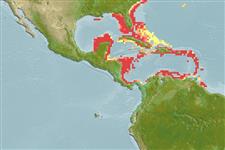
Sessile; djupintervall 0 - 100 m (Ref. 847). Tropical; 34°N - 8°N, 92°W - 58°W (Ref. 847)
Western Central Atlantic: Caribbean Sea.
Längd vid första mognad / Storlek / Vikt / Ålder
Könsmognad: Lm ? range ? - ? cm
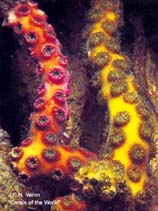
Colonies may be zooxanthellate or azooxanthellate depending on light availability. Azooxanthellate colonies form extensive banks while zooxanthellate colonies form clumps of tapered fused branches less than 0.5 meters across. Corallites are exsert with septa in three cycles.
Maximum depth range from Ref. 119373. Associated with several species of pycnogonids (Ref. 121217).
Livscykel och parningsbeteende
Könsmognad | Reproduktion | Lek | Ägg | Fekunditet | Larver
Members of the class Anthozoa are either gonochoric or hermaphroditic. Mature gametes are shed into the coelenteron and spawned through the mouth. Life cycle: The zygote develops into a planktonic planula larva. Metamorphosis begins with early morphogenesis of tentacles, septa and pharynx before larval settlement on the aboral end.
Waller, R.G. and P.A. Tyler 2005 The reproductive biology of two deep-water, reef building scleractinians from the North East Atlantic Ocean. Springer-Verlag. Coral Reefs. 24:514-522. (Ref. 810)
Status på IUCN:s rödlista
(Ref. 130435: Version 2025-2 (Global))
CITES-status (Ref. 108899)
Not Evaluated
Hot mot människor
Mänskliga användningsområden
FAO - Publication: search | FishSource |
Verktyg
Ytterligare information
Trofisk ekologiLivsmedelsartiklar (preys)
Födosammansättning
Födointag
Predatorer
PopulationsdynamikTillväxt
Max. åldrar / storlekar
Längd-vikt rel.
Längd-längd rel.
Längd-frekvenser
Massakonvertering
Abundans
LivscykelReproduktionKönsmognadFekunditetLekÄggUtveckling av äggLarver MänniskorelateradFrimärken, mynt, diverse.
Internet-källor
Uppskattningar baserade på modeller
Sårbarhet i fisket
(Ref. 71543) |
(0 of 100). |
Priskategori
(Ref. 80766): |
Unknown. |