Hexacorallia |
Scleractinia |
Fungiidae
Environment: milieu / climate zone / depth range / distribution range
Ecology
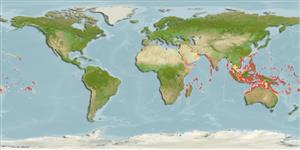
Reef-associated; depth range 0 - 40 m (Ref. 847). Tropical; 30°N - 31°S, 32°E - 137°W (Ref. 847)
Indo-Pacific.
Length at first maturity / Size / Weight / Age
Maturity: Lm ? range ? - ? cm Max length : 25.0 cm TL male/unsexed; (Ref. 269)
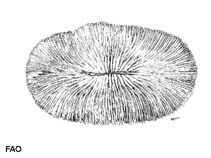
Specimens of this species are elongate (up to 25 by 13 cm), thick, and heavy, and may have an elevated central portion (tentacular lobe). The septa are neatly arranged, subequal and have very fine dentations giving the coral a smooth appearance, and the attachment scar is often not discernible (Ref. 269).
Life cycle and mating behavior
Maturity | Reproduction | Spawning | Eggs | Fecundity | Larvae
Mature gametes are shed into the coelenteron and spawned through the mouth. Life cycle: The zygote develops into a planktonic planula larva. Metamorphosis begins with early morphogenesis of tentacles, septa and pharynx before larval settlement on the aboral end (Ref. 833).
Hodgson, G. 1998 Corals. p. 101-122. In Carpenter, K.E. and V.H. Niem (eds) FAO species identifidication guide for fishery purposes. The living marine resources of the Western Central Pacific. Vol. 1. Seaweeds, coral, bivalves and gastropods. FAO Rome. (Ref. 269)
IUCN Red List Status
(Ref. 130435: Version 2025-2 (Global))
CITES status (Ref. 108899)
Not Evaluated
Threat to humans
Human uses
FAO - Publication: search | FishSource |
Tools
More information
Trophic EcologyFood items (preys)
Diet composition
Food consumption
Predators
Population dynamicsGrowth
Max. ages / sizes
Length-weight rel.
Length-length rel.
Length-frequencies
Mass conversion
Abundance
PhysiologyOxygen consumption
Human RelatedStamps, coins, misc.
Internet sources
Estimates based on models
Fishing Vulnerability
(Ref. 71543) |
Low vulnerability (15 of 100). |
Price category
(Ref. 80766): |
Unknown. |