This website uses cookies to enhance your browsing experience and ensure the functionality of our site. For more detailed information about the types of cookies we use and how we protect your privacy, please visit our Privacy Information page..
×
Cookie Settings
This website uses different types of cookies to enhance your experience. Please select your preferences below:
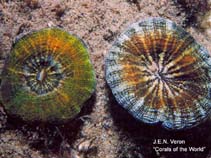
In subtropical localities: often flat, solitary, and less than 60 mm across. In the tropics: larger, sometimes colonial. The slope of the septa up from the columella to an indistinct wall and the slope down of the costae to the periphery gives the fleshy mantle of the polyps a distinct concentric texture. Secondary centers present near the colony center and around the periphery. Sturdy septo-costae have large blunt teeth. Color: usually dark green or tan (Ref. 848).
Maximum depth from Ref. 98471. Occurs in most reef environments (Ref. 848).
Hermaphroditic (Ref. 113712). Mature gametes are shed into the coelenteron and spawned through the mouth. Life cycle: The zygote develops into a planktonic planula larva. Metamorphosis begins with early morphogenesis of tentacles, septa and pharynx before larval settlement on the aboral end (Ref. 833).