Hexacorallia |
Scleractinia |
Lobophylliidae
Umwelt: Milieu / Klimazone / Tiefenbereich / Verbreitungsgebiet
Ökologie
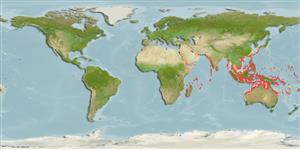
Riff-verbunden; tiefenbereich 0 - 50 m (Ref. 848). Tropical; 36°N - 31°S, 32°E - 172°W (Ref. 848)
Indo-Pacific: Red Sea and eastern Africa, including Madagascar, east to Tonga, north to southern Japan, south to Kermadec Islands.
Länge bei der ersten Reifung / Größe / Gewicht / Alter
Geschlechtsreife: Lm ? range ? - ? cm
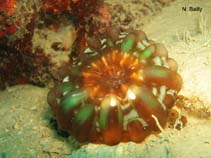
Monocentric, oval or circular, and cylindrical. Base for attachment: present, pointed when free-living. Thick primary septa with extremely large, rounded, or lobed teeth. Paliform lobes usually well developed. Broad and compact columellae. Tentacles extend only at night. Toothed primary septo-costae clearly visible during the day when water inflates the mantle, which is translucent. Mantle may exceed twice the diameter of the skeleton in low light conditions. Color: often a mix of green or brown; pink and other colors possible (Ref. 848).
Maximum depth from Ref. 98471. Occurs in protected reef environments and deep sandy substrates (Ref. 848).
Lebenszyklus und Paarungsverhalten
Geschlechtsreife | Fortpflanzung | Ablaichen | Eier | Fruchtbarkeit | Larven
Hermaphroditic (Ref. 113708). Mature gametes are shed into the coelenteron and spawned through the mouth. Life cycle: The zygote develops into a planktonic planula larva. Metamorphosis begins with early morphogenesis of tentacles, septa and pharynx before larval settlement on the aboral end (Ref. 833).
Veron, J.E.N. 2000 Corals of the world. Volume 3. Australian Institute of Marine Science and CRR Qld. Pty. Ltd. Australia. 490 p. (Ref. 848)
IUCN Rote Liste Status
(Ref. 130435: Version 2025-2 (Global))
CITES Status (Ref. 108899)
Not Evaluated
Bedrohung für Menschen
Nutzung durch Menschen
FAO - Publication: search | FishSource |
Tools
Mehr Information
Trophische ÖkologieLebensmittel (Beutetiere)
Nahrungszusammensetzung
Nahrungsaufnahme
Räuber
PopulationsdynamikWachstum
Max. Alter/Größen
Länge-Gewicht-Rel.
Länge-Länge-Verhältnis.
Längenhäufigkeiten
Massenkonvertierung
Dichte
LebenszyklusFortpflanzungGeschlechtsreifeFruchtbarkeitAblaichenEierEientwicklungLarven PhysiologieSauerstoffverbrauch
MenschenbezogenBriefmarken, Münzen, Verschiedenes.
Internet Quellen
Schätzungen auf der Grundlage von Modellen
Anfälligkeit der Fischerei
(Ref. 71543) |
(0 of 100). |
Preiskategorie
(Ref. 80766): |
Unknown. |