Hexacorallia |
Scleractinia |
Plerogyridae
Entorno: milieu / zona climática / rango de profundidad / gama de distribución
Ecología
Asociado a arrecife; rango de profundidad 0 - 40 m (Referencia 848). Tropical; 31°N - 34°S, 26°E - 176°E (Referencia 848)
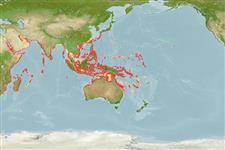
Indo-Pacific: widespread in East Africa including the Red Sea to New Caledonia, north to Ryukyu Islands, south to Great Barrier Reef, Australia.
Longitud en la primera madurez / Tamaño / Peso / Edad
Madurez: Lm ? range ? - ? cm
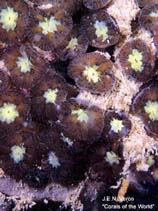
Formation: phaceloid to plocoid, with few to numerous corallites. Corallites are less than 7 mm diameter. Septa: mostly in two cycles, with only the first reaching the columella; primary septa may be exsert. Poorly developed columellae. Mantles extend during the day and may form a continuous surface obscuring the underlying growth-form. Color: commonly dark red with obvious green oral discs, also pink, orange, brown or uniform dark grey with white margins to primary septa (Ref. 848).
Occurs in reef environments where water is turbid (Ref. 848). Also in deep, steep slopes and crevices (Ref. 98471).
Ciclo vital y comportamiento de apareamiento
Madurez | Reproducción | Puesta | Huevos | Fecundidad | Larva
Members of the class Anthozoa are either gonochoric or hermaphroditic. Mature gametes are shed into the coelenteron and spawned through the mouth. Life cycle: The zygote develops into a planktonic planula larva. Metamorphosis begins with early morphogenesis of tentacles, septa and pharynx before larval settlement on the aboral end.
Veron, J.E.N. and G. Hodgson 1989 Annotated checklist of the hermatypic corals of the Philippines. Pacific Science 43:234-287. (Referencia 8817)
Situación en la Lista Roja de la UICN
(Referencia 130435: Version 2025-2 (Global))
Estatus CITES (Referencia 108899)
CMS (Referencia 116361)
Not Evaluated
Amenaza para el ser humano
Usos humanos
FAO - Publication: search | FishSource |
Herramientas
Más información
Ecología TróficaAlimentos (presas)
Composición de la dieta
consumo de alimento
Despredadores
Dinámica de la poblaciónCrecimiento
Edades / tallas máximas
Longitud-peso rel.
Longitud-longitud rel.
Longitud-frecuencias
Conversión de masas
Abundancia
Ciclo de vidaReproducciónMadurezFecundidadPuestaHuevosDesarrollo de los huevosLarva FisiologíaConsumo del oxígeno
Relacionados con el ser humanoSellos, monedas, varios
Fuentes de Internet
Estimaciones basadas en modelos
Vulnerabilidad pesquera
(Referencia 71543) |
(0 of 100). |
Categoría de precios
(Referencia 80766): |
Unknown. |