Hexacorallia |
Scleractinia |
Lobophylliidae
Milieu: milieu / Klimaatzone / Diepte / verspreidingsgebied
Ecologie
Rifbewoner; diepte 0 - 40 m (Ref. 848). Tropical; 36°N - 34°S, 32°E - 135°W (Ref. 848)
Indo-Pacific: widespread in East Africa, including Red Sea to Polynesia, north to Japan and south to Solitary Islands, Australia.
Lengte bij maturiteit / Grootte / Gewicht / Leeftijd
Maturiteit: Lm ? range ? - ? cm
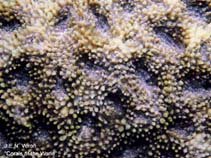
Formation: encrusting to massive, rarely over 1 m across. Corallites: cerioid or subplocoid, circular, with thick walls. Septa have long pointed teeth. Thick fleshy tissue over the skeleton present, usually forming concentric folds. Color: uniform or mottled dull brown, gray or green, but can also be brightly colored (Ref. 848).
Occurs in most reef environments (Ref. 848).
Levenscyclus en paargedrag
Maturiteit | Voortplanting | Paaien | Eieren | Fecunditeit | Larven
Hermaphroditic (Refs. 113708, 113712). Mature gametes are shed into the coelenteron and spawned through the mouth. Life cycle: The zygote develops into a planktonic planula larva. Metamorphosis begins with early morphogenesis of tentacles, septa and pharynx before larval settlement on the aboral end (Ref. 833).
Veron, J.E.N. and G. Hodgson 1989 Annotated checklist of the hermatypic corals of the Philippines. Pacific Science 43:234-287. (Ref. 8817)
Status op de Rode Lijst van het IUCN
(Ref. 130435: Version 2025-2 (Global))
CITES status (Ref. 108899)
Not Evaluated
Gevaar voor de mens
Gebruik door de mens
FAO - Publication: search | FishSource |
Tools
Meer informatie
Trofische ecologieVoedsel (prooien)
Dieetsamenstelling
Voedselconsumptie
Predatoren
PopulatiedynamicaGroei
Max. leeftijden / maten
Lengte-gewicht rel.
Lengte-lengte rel.
Lengtefrequenties
Massaconversie
Abundantie
FysiologieZuurstofverbruik
Menselijk gerelateerdPostzegels, munten, diversen.
Internetbronnen
Schattingen op basis van modellen
Kwetsbaarheid van de visserij
(Ref. 71543) |
(0 of 100). |
Prijsklasse
(Ref. 80766): |
Unknown. |