Scyphozoa |
Rhizostomeae |
Mastigiidae
Environnement : milieu / zone climatique / profondeur / gamme de distribution
Écologie
Pélagique; profondeur 0 - 20 m (Réf. 116114), usually 1 - 1 m (Réf. 3264). Tropical
Indo-Pacific, Western Atlantic and the Mediterranean.
Longueur à la première maturité / Taille / Poids / Âge
Maturité: Lm ? range ? - ? cm Max length : 60.0 cm WD mâle / non sexé; (Réf. 3021)
Description synthétique
Morphologie
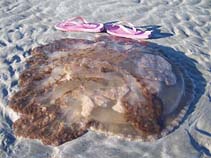
Typically bluish-brown with numerous evenly distributed opaque white spots. Has eight thick transparent branching oral arms with large brown bundles of stinging cells at the end.
Neritic (Ref. 116114). Swims near the surface in murky waters near estuaries in harbors and embayments (Ref. 3248). Also found in mangroves (Ref. 116581). Commensals: host to Charybdis feriata megalopa (Ref. 116535).
Cycle de vie et comportement reproducteur
Maturité | Reproduction | Frai | Œufs | Fécondité | Larves
Members of the class Scyphozoa are gonochoric. Life cycle: Egg is laid by the adult medusa which later develops into a free-living planula, then to a scyphistoma to a strobila, and lastly to a free-living young medusa.
Migotto, A.E., A.C. Marques, A.C. Morandini and F.L. da Silveira 2002 Checklist of the cnidaria medusozoa of Brazil. Biota Neotropica 2(1):1-31. (Réf. 813)
Statut dans la liste rouge de l'IUCN
(Réf. 130435: Version 2025-2 (Global))
statut CITES (Réf. 108899)
Not Evaluated
Not Evaluated
Menace pour l'homme
Utilisations par l'homme
FAO - Publication: search | FishSource |
Outils
Plus d'informations
Dynamique des populations Cycle de vieReproductionMaturitéFéconditéFraiŒufsDéveloppement de l'œufLarves PhysiologieConsommation d'oxygène
Liées à l'hommeTimbres, pièces de monnaie, divers
Sources Internet
Estimations basées sur des modèles
Résilience
(Ref. 69278): |
Haut, temps minimum de doublement de population inférieur à 15 mois (K=2.3-4.69) |
Vulnérabilité de la pêche
(Réf. 71543) |
Low to moderate vulnerability (27 of 100). |
Catégorie de prix
(Réf. 80766): |
Unknown. |