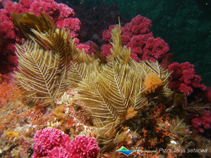
Hydrozoa |
Leptothecata |
Plumulariidae
Environnement : milieu / zone climatique / profondeur / gamme de distribution
Écologie
Sessile; profondeur 0 - 370 m (Réf. 116013). Temperate
Atlantic, Pacific and Indian Oceans. Temperate and subtropical.
Longueur à la première maturité / Taille / Poids / Âge
Maturité: Lm ? range ? - ? cm Max length : 25.0 cm TL mâle / non sexé; (Réf. 7703)
Known from shallow coastal benthic habitats (< 25m), deeper coastal substrates (25-100m) of the offshore fore-reef slope, Banks and upper slope (> 100m), tops of Challenger and Argus seamounts (Ref. 86643). Also found in Carrie Bow Cay, Belize, in patch reefs, mangrove islands, Thalassia sp. beds, reef crest, low spur and groove zones, sand trough, outer ridge and fore-reef slopes on algae, Thalassia sp. blades, mangrove roots, floating Sargassum sp. and substrates composed of dead corals and gorgonians at depths of 0 to 31m. As with other hydroids, this species exhibits a pelagic medusoid stage (Ref. 87156).
Cycle de vie et comportement reproducteur
Maturité | Reproduction | Frai | Œufs | Fécondité | Larves
Reproduction occurs only in hydroid stage (Ref. 1663, p. 21). Gonochoristic. Sperm swim from the male gonophore to fertilize the eggs held on female gonophores. Fertilized eggs develop into ciliated planula larvae, swim and crawl; metamorphoses into a hydroid (Ref. 1663).
Migotto, A.E., A.C. Marques, A.C. Morandini and F.L. da Silveira 2002 Checklist of the cnidaria medusozoa of Brazil. Biota Neotropica 2(1):1-31. (Réf. 813)
Statut dans la liste rouge de l'IUCN
(Réf. 130435: Version 2025-2 (Global))
statut CITES (Réf. 108899)
Not Evaluated
Not Evaluated
Menace pour l'homme
Utilisations par l'homme
FAO - Publication: search | FishSource |
Outils
Plus d'informations
Écologie trophiqueAliments (proies)
Composition du régime alimentaire
Consommation alimentaire
Prédateurs
Dynamique des populations PhysiologieConsommation d'oxygène
Liées à l'hommeTimbres, pièces de monnaie, divers
Sources Internet
Estimations basées sur des modèles
Vulnérabilité de la pêche
(Réf. 71543) |
Low vulnerability (13 of 100). |
Catégorie de prix
(Réf. 80766): |
Unknown. |